Acadia National Park, established on July 8, 1916, is a 47,000-acre patchwork of conservation land in the upper coastal region of Maine. Spread out across much of Mount Desert Island (the largest island on the coast of Maine and the sixth largest in the contiguous United States), Isle au Haut, and the Schoodic Peninsula, Acadia comprises the best of what coastal Maine has to offer: stunning ocean scenery, towering granite mountains, dense woodland, and miles of beaches. Today, Acadia National Park draws roughly 3 million visitors annually, 1 making it one of the most popular, albeit one of the smallest, national parks in the country. But how did this remote, rugged island come to be the home of one of the most sought-after parks in America? This project seeks to answer the question at hand by examining the unique history of Mount Desert Island as a place torn between the influences of French and British settlers, the artistic efforts of the Rusticator movement and the subsequent tourism boom, and how these events and movements ultimately gave way to the birth of Acadia.
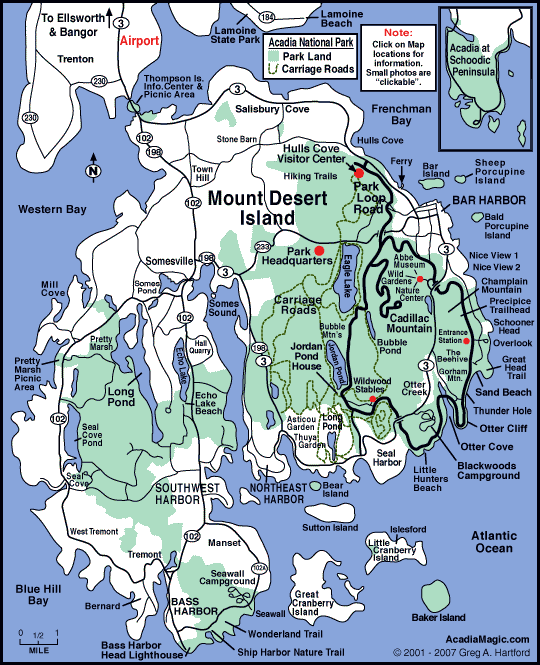
Before the arrival of European settlers, Mount Desert Island was largely unpopulated save for a scattering of Wabanaki people. These original islanders, who referred to the island as Pemetic – meaning “mountain range” – were subsistence hunter-gatherers, living in camps on the shores of the island. They thrived among the abundance of natural resources, collecting shellfish along the coast and fishing in the waters offshore. 2 The first European to glimpse the island was John Cabot, in 1497. 3 Roughly one hundred years later, Samuel Champlain first described Mount Desert Island, noting its peaks’ lack of trees, and was also the first to accurately observe that it was an island, where previous explorers had assumed it was connected to the mainland. He called the island L’isle des Monts-déserts. 4
Although Mount Desert Island had been observed and mapped from a distance, it remained uninhabited by Europeans until the early seventeenth century. 5 In 1613, Jesuit missionaries sent to the coast of Maine from France set up a mission on Mt. Desert Island. After having been adrift at sea in an impermeable fog for two days, they emerged from the mist off the shore of the island and made landfall. In Mount Desert Island, and the Cranberry Isles (1871), the author, E.H. Dodge, writes, “They effected a landing … set up a cross, and in gratitude for their escape from the maddened elements, dedicated the spot ‘Saint Sauveur’”. 6 Shortly after the establishment of their mission, in 1614, the British captain Samuel Argall was dispatched to Mt. Desert Island from Jamestown, Virginia, to rid the island of what the British saw as intruders on land under the claim of the British Crown. A fourteen-gun warship at his disposal, Argall overwhelmed the Jesuit encampment, and returned to Jamestown with the Jesuits his prisoners. This skirmish is sometimes referred to as the Battle on Mount Desert Island. 7

Battles like these between the British and the French were common during the seventeenth century in Maine – both nations had laid claim to the same swath of territory in North America – and proved to be an effective deterrent for would-be settlers on Mt. Desert Island. In 1688, amidst the tensions between the colonial powers, King Louis XIV of France granted 100,000 acres of the Maine coast, totally encompassing Mt. Desert Island, to a French lawyer by the name of Antoine Laumet. Laumet, who went by the fabricated moniker Antoine de La Mothe, Sieur de Cadillac, 8 was the island’s sole proprietor until 1713 when he was forced to leave. The Treaty of Utrecht, solidified in 1713, granted the whole of Maine to Great Britain. George Bucknam Dorr, the “Father of Acadia”, contends, “If communication with Quebec was difficult, that with Boston was easy; and thus Acadia became largely dependent on its New England neighbors” 9. Laumet would eventually go on to establish the city of Detroit. 10 The island, bereft of its only landowner, would remain vacant of Europeans until 1761.
As the author E. H. Dodge writes, “The ‘Modern History’ of Mt. Desert dates back to the spring of 1761, when Captain Abraham Somes of Gloucester, Mass., took up a land grant as a part of that commonwealth” 11. While Somes’ landholdings on the island were revoked during the American Revolution due to his affiliation with the British Crown, they were granted to his son, who partook in the rebellion. The land that was previously owned by Laumet was ceded to his granddaughter as a measure of goodwill between the newly formed United States and France. These two landowners would gradually parcel off their land to fishermen and traders over the course of the next few decades. By the late 1700s, the population of the island had swelled to the thousands, primarily reliant on an agricultural and fishing economy. The women of Mt. Desert Island were mainly employed as farmers and worked the land, while the men were bound to the sea, responsible for fishing and sailing, and at the time were regarded “unquestionably the best sailors in the world” 12.
Looking back at the history of Mt. Desert Island, it is no surprise that the island was left largely untouched for the greater part of the nearly two hundred years since its discovery. The trend between the British and the French of making land-grabs and laying claim to large portions of territory served to thwart one another’s efforts to settle the island. Should this have not been the case, the island would have been settled much earlier and possibly would have experienced development and resource extraction on a larger scale, robbing the island of the natural beauty that would draw the Rusticators to its shores in the 1840s.
At the onset of the American Industrial Revolution, a rapidly increasing demand for fish, timber, granite, ice, and ships transformed Maine into an economic powerhouse. Commenting on this period, Kaiser writes, “It seemed as if everything in Maine turned to gold” 13. Maine’s abundant natural resources and climate livened its fishing, lumber, granite, and ice industries, and its harbors built and housed the ships that supported a massive coastal shipping industry.
However, the introduction of the railroad devastated Maine’s mercantile dominance, as transportation was no longer dependent on oceangoing vessels. This also dealt a devastating blow to the state’s fishing industry, as equipment prices skyrocketed. Other developments of the Industrial Revolution made obsolete the granite and ice industries, which occupied a significant portion of the state’s economy. This economic downturn rendered the coastal islands unfit for commerce and were soon largely abandoned. It was in this industrial vacuum that coastal Maine resorted to tourism, which had been growing in popularity during the Industrial Revolution, to prop up its economy. Ironically enough, the railroads ended up facilitating tourists’ access to far-flung places in coastal Maine – far-flung places like Mt. Desert Island 14.
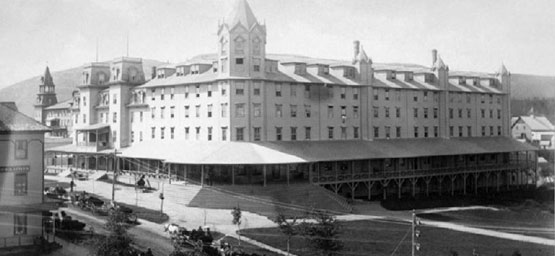
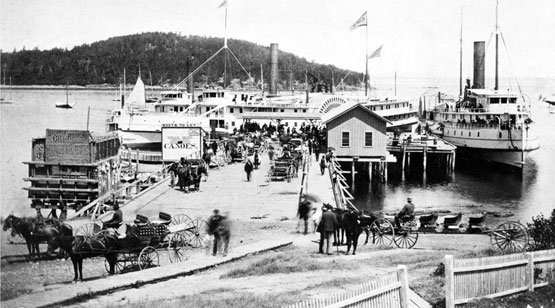
The Rusticators had a profound impact on how perceptions of Mt. Desert Island changed from a collection of lonely, isolated fishing hamlets to an attraction of unmatched natural beauty. This artistic movement, comprised of painters, poets, and writers, increased the appeal of the island by storying the landscape, both visually and narratively. This appeal naturally drew tourists, and given the temporally and monetarily exhaustive trip to Mt. Desert Island, most of the tourists were wealthy vacationers who could afford the multi-day travel. By 1868, travel to the island was facilitated by a direct steamboat service between Boston and Bar Harbor, the “gateway to Acadia” 15.
In the following decades, the tourist population soared and demand for hotels and other various lodgings on the island boomed, and by 1882 Bar Harbor’s 400-room Rodick Hotel was the largest hotel in Maine 16. By that time, a direct train route was available from Boston to Hancock Point, the nearest mainland node to Mt. Desert Island, and roughly a decade later travel to the once-exotic getaway could be made in less than a day. This revolution in transportation to the island brought unprecedented numbers of tourists from the cities, and the island’s exclusive atmosphere soon evaporated. As a result, Mt. Desert Island’s wealthiest vacationers were compelled to remove themselves from the increasingly middle-class hotel scene and began purchasing large tracts of land to erect private mansions to host exclusive dinner parties among their peers 17.
The Rusticators were a group of artists, belonging to the Hudson River School artistic movement, who traveled to Mt. Desert Island to paint and write about its magnificent scenery. In keeping with the trend of the time, these artists opened up the world of “exotic” landscapes in New England to the masses back home in the cities, fostering a new desire to witness the natural beauty that these landscapes had to offer. European romantics had criticized New England’s scenery and its primary shortcoming, as Brown discusses, was its “lack of associations … [which] was easily remedied by the appropriate artistic intervention” 18. The Rusticators proved to be the “appropriate artistic intervention” that Mt. Desert Island’s scenery sorely needed.
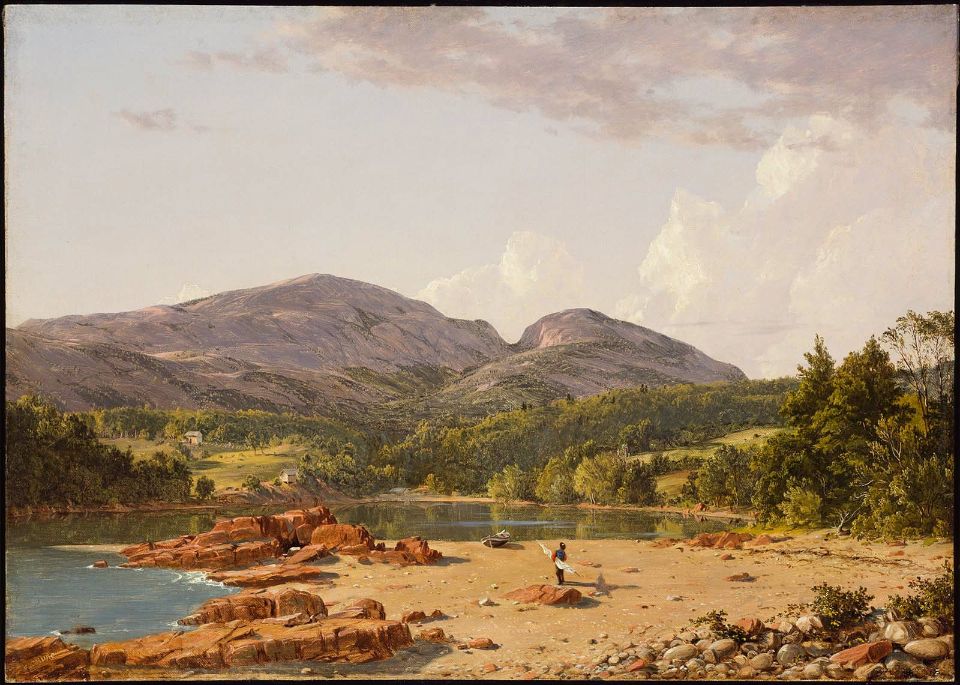
Painters like Thomas Cole and his student, Frederic Edwin Church, were among the first to travel to Mt. Desert Island to impress its scenery onto their canvasses. Cole, an emerging landscape artist, first traveled to Mt. Desert Island in 1844. His paintings of the island depicted “dramatic scenes” of the rugged coastline and stressed the ferocity of the ocean 19. Although his work received primarily negative reviews, it drew considerable interest from the public. Shortly after, Cole’s student, Frederic Church, traveled to Mt. Desert Island and produced captivating landscape scenes of places around the island that drew thousands of people to his exhibitions in New York. Following Church’s depictions of the island, Kaiser writes, “Mount Desert Island found itself thrust into the national spotlight” 20. In the spirit of nineteenth-century Romanticism, author E. H. Dodge writes, “The eastern scenery [of Mt. Desert Island] is wild and awfully grand, and the western, placid and sublime, like nature in her milder mood” 21.
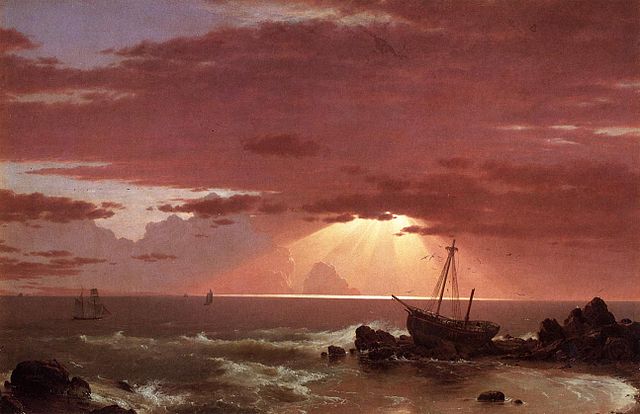

The Rusticators took advantage of the recent economic drought on Mt. Desert Island by paying residents, most of them local fishermen, to board in their homes while they composed the island’s landscapes into paintings, poems, and stories. The few residents of the island at the time found the arrival of the Rusticators to be of economic value to them, as they provided the islanders with an additional source of income. This was the birth of scenic tourism on Mt. Desert Island; it was not only born out of the public’s recognition for the island’s beauty but of the economic necessity of the island’s residents.
Acadia National Park, as we know it today, was established as the result of a massive land conservation campaign launched by George Bucknam Dorr and Charles Eliot in 1901. Motivated by fears that increasing rates of tourism would overdevelop the island, as well as lumber companies taking advantage of land-clearing objectives, Dorr and Eliot formed the Hancock County Trustees of Public Reservations (HCTPR) in 1901 to protect the island’s bountiful natural beauty 22. The ratification of the Sixteenth Amendment in 1913, which instituted the federal income tax, facilitated Dorr and Eliot’s mission because it drove many of the island’s wealthiest landowners to sell their lavish estates. By that year, the HCTPR had acquired 6,000 acres of land to be set aside for conservation. After a relentless battle to place the HCTPR’s lands under federal protection, President Woodrow Wilson signed into existence the Sieur de Monts National Monument in 1916 23. The park was elevated to national park status in 1919 and was named Lafayette National Park, only to be changed to Acadia National Park in 1929 at the behest of wealthy landowners on the Schoodic Peninsula, who would not donate land to a park with a name that “sounded too French” 24.
The tradition of natural conservation on Mt. Desert Island, originally inspired by George Dorr, was still alive, and Acadia continued to expand through massive land donations. The Bostonian landscape artist Ernest Bowditch, along with a handful of his peers, purchased land on Isle au Haut and established the Point Look-Out Club. The club, originally strictly for men – in its later years women, children and dogs would be permitted to stay – was an exclusive getaway complete with cottages and a clubhouse. By the mid-1940s the family was in possession of 3,000 acres of land on the island, which was then donated to Acadia National Park 25.
In conclusion, Acadia National Park exists today as a byproduct of centuries of land-grabbing between colonial powers, industries, vacationers, and conservationists. The Rusticators discovered Mt. Desert Island, largely devoid of people and significant development, and sparked a decades-long battle between wealthy landowners, middle-class tourists, and nostalgic conservationists who dreamed of maintaining the island’s natural beauty that brought droves of people there in the first place. From the smoke of this battle emerged Acadia National Park, a place with a colorful history, rich culture, and unparalleled scenery.
I am a student of Geography at Dartmouth College in Hanover, New Hampshire, but New Jersey is where I call home. Although I grew up in northern NJ, I spent a significant portion of my childhood summers vacationing along the coast of Maine with my family, who has been making the annual trek to Maine since the 1970s. Acadia National Park holds a special place in my heart, and my experiences there were the inspiration for this research project.
Cover image courtesy of Visit Portland
Kaiser, James. Acadia: the complete guide. Destination Press, 2016. ↩
Kaiser, Acadia: the complete guide, 2016. ↩
Dodge, E.H. Mount Desert Island, and the Cranberry Isles. 1871. ↩
Kaiser, 2016: 109. ↩
Kaiser, 2016; Dodge, Mount Desert Island, 1871; Dorr, George Bucknam. The Sieur de Monts National Monument as commemorating Acadia and early French influences of race and settlement in the United States. Bar Harbor, ME: Wild Gardens of Acadia., 1917. ↩
Dodge, 1871: 11. ↩
Dodge, 1871; Kaiser, 2016; Dorr, Sieur de Monts, 1917. ↩
Kaiser, 2016: 111. ↩
Dorr, 1917. ↩
Dodge, 1871; Kaiser, 2016. ↩
Dodge, 1871: 24. ↩
Kaiser, 2016: 112. ↩
Ibid., 116. ↩
Ibid., 116-118. ↩
Ibid., 122. ↩
Ibid. ↩
Kaiser, 2016; Caldwell, Bill. Islands of Maine: where America really began. Portland, ME: Guy Gannett Publishing Co., 1981. ↩
Brown, Dona. Inventing New England: regional tourism in the nineteenth century. Washington: Smithsonian Institution Press, 1995: 58. ↩
Kaiser, 2016: 118. ↩
Ibid., 118. ↩
Dodge, 1871: 17. ↩
U.S. Department of the Interior. “George B. Dorr (U.S. National Park Service).” National Parks Service. October 22, 2015. Accessed October 10, 2017. ↩
US Dept. of the Interior, 2015. ↩
Caldwell, Islands of Maine, 1981. ↩
Ibid. ↩