We imagine public parks to be melting pots in which all races and classes interact with space and their surrounding landscape equitably. Here I ask you to reimagine the idealized public park. Think of a park that is divided: the WASPy visitors are having an ornate wedding in the park’s preserved mansion in the center of the park while the working class, immigrant family is having a picnic on the outskirts of the park. There is no interaction between the two groups – only the smell of barbecue reminding the wedding attendees they are not alone. This park has a name: Harkness Memorial State Park.
Harkness Memorial State Park, or Harkness Park for short, is a 230-acre park located in Waterford, Connecticut on Long Island Sound. Harkness Park is centered around the Eolia mansion, a 42-room Renaissance Revival mansion built in 1906, and the adjacent botanical gardens.1
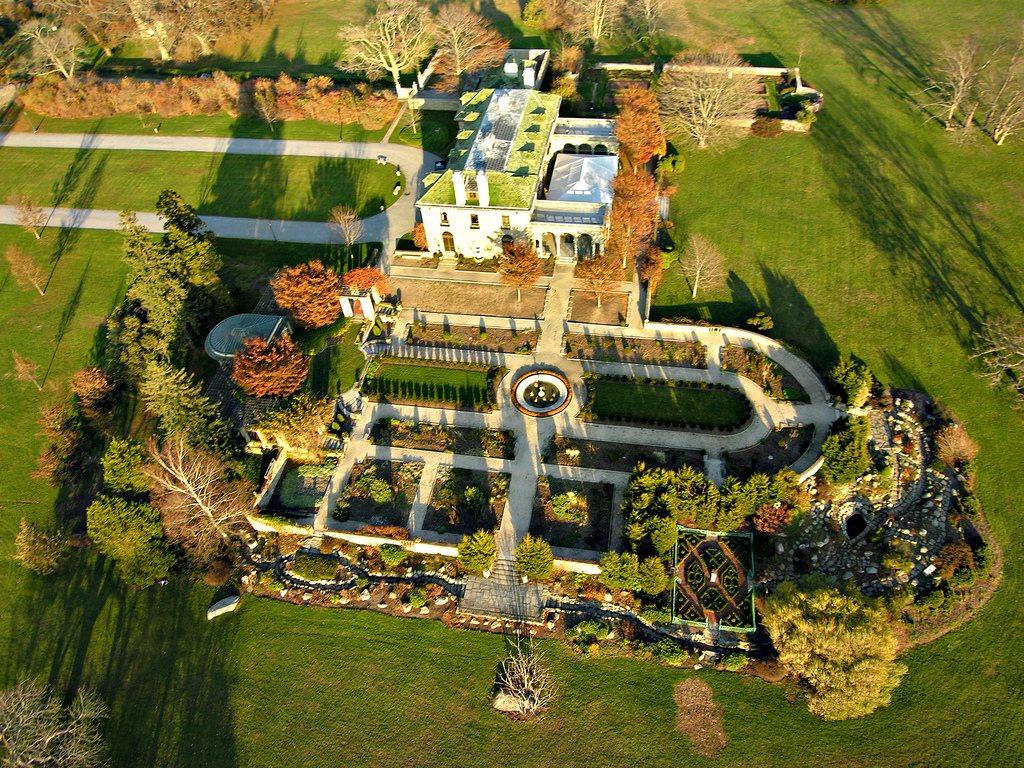
Edward Stephen Harkness and his wife, Mary Harkness, purchased the estate in 1907, one year after its construction. The couple amassed their fortune from Edward Harkness’ father, Stephen V. Harkness, who was an initial investor in the Standard Oil Corporation alongside John D. Rockefeller. In 1950, ten years after Edward Harkness’ death, Mary Harkness bequeathed the estate to the people of Connecticut to increase the amount of interaction local citizens have with nature.2 In 1952, the estate became part of the Connecticut state park system and since the 1980s, the Department of Energy and Environmental Protection (DEEP) has overseen management of the property.3
In this project I will analyze three distinct features, both outside of and within the Harkness Park landscape:
While physically distinct, these three spaces evoke an overlapping thematic narrative which work in unison to prove that Mary Harkness’ goal to maximize locals’ exposure to nature has yet to be achieved. This is because the cultural associations and physical components of Harkness Park cater to the ‘profound sentimentalization’ of the landscape - a longing to return to an earlier time and place – which alienates members of nonhegemonic identities and alters the way they interact with the Harkness Park landscape.4
In order to analyze the performativity of these nonhegemonic identities in Harkness Park, it is first necessary to debunk the fallacy that Connecticut is a WASPy monolith. I use Social Explorer to compare Waterford, a town that conforms to our conception of Connecticut, to New London and Norwich, two neighboring cities that rupture this same conception.
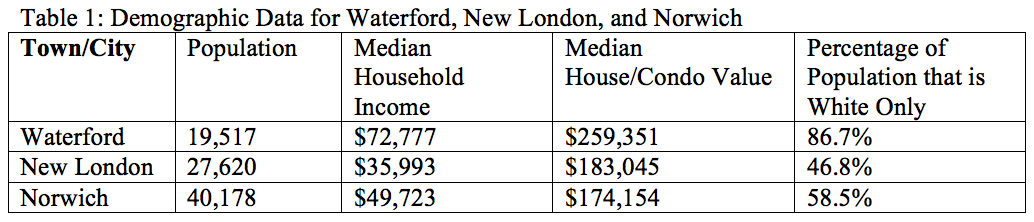
The data in Table 1 depicts the diversity of southeastern Connecticut.5 Considering the significant cohort of low socioeconomic status (SES) racial minorities in the area and the geographic proximity of the three locations, it is fair to conclude that locals of varying SES and race are visiting Harkness Park.
It would be foolish to believe that Harkness Park is the only park accessible to the roughly 85,000 residents of these three towns. Each town boasts its own small local park(s). Yet the most frequented parks in the area are the two state parks - Harkness Memorial State Park in Waterford and Fort Trumbull State Park in New London. The fact that both these towns house state parks might seem to reinforce the misconception that public parks are equitable spaces that transcend economic and racial discrepancies. However, this ideology crumbles upon a within-town and within-city analysis. In Waterford, the neighborhood in which Harkness Park is located has a median household income of $99,643 and two New London neighborhoods adjacent to Fort Trumbull State Park have median household incomes of $82,989 and $95,179.6 As exemplified by these two parks, the desire for the wealthy to live near public parks resulted in a regressive redistribution of residential communities in which the poorer were concentrated and pushed farther from said parks.7
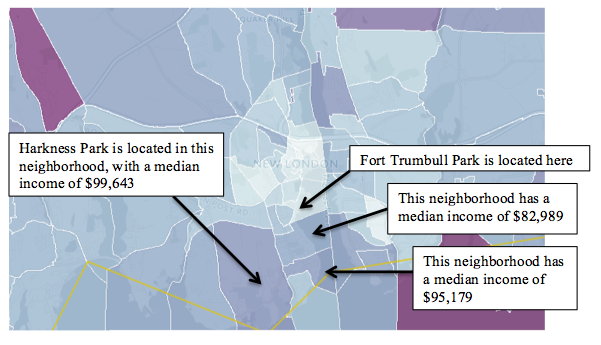
In southeastern Connecticut, and New England more generally, there is, and always has been, a direct relationship between wealth and public parks. It is no coincidence that the two state parks in southeastern Connecticut are located in or adjacent to the most affluent neighborhoods in the region. Historically, there was a similar correlation between public parks and wealth in Boston at the time of conception of the Boston Common.
During the mid- to late 18th century, Boston began to spatially expand while the elite simultaneously sought residential locations removed from the commercial heart of the city. The Boston elite used their power and prestige to actively keep the Common as their symbolic front yard. The Common, devoid of commercialization, came to symbolize the intelligence and refinement the Boston elite believed were necessary for a polished civilization.8 Likewise, Waterford was seen as a space for Connecticut elite, especially the elite who had a tie to New London. While no longer the case, New London has historically been a lucrative commercial hub. In the 19th century, New London was the second-largest whaling and sealing port in New England.9 Many of the elite who amassed their fortunes in the area turned to less commercialized landscapes like Waterford to build their homes and estates. Consequently, these landscapes evolved into bastions of wealth and privilege.
The point here is simple: there has always been a strong correlation between wealth and landscapes that still remains today. Harkness Park is located in the wealthiest neighborhood in an already relatively wealthy town. Even the surname ‘Harkness’ that the park is named after is a direct connection to wealth. Mr. and Mrs. Harkness, major philanthropists, donated approximately $200 million to local institutions, including Connecticut College, Yale University, and Trinity College. This reinforces the privilege and prestige associated with the Harkness family.10 These reminders of the relationship between wealth and landscapes alienate lower SES locals in the area, not because they cannot afford the cost of entering the park ($9 and $6 for residents of Connecticut on weekends and weekdays, respectively), but because they are forced to enter a landscape that was never intended or designed to include them in the first place.11
The Eolia mansion and adjacent botanical gardens are the undeniable physical and cultural focal point of Harkness Park. The map above shows the central position of the mansion in the park. As stated earlier, the Eolia mansion and botanical gardens were undoubtedly designed and constructed with a wealthy buyer in mind. I argue in this section that the architecture and aesthetics of the Eolia mansion and botanical gardens alienate nonhegemonic identities by serving as symbols of white elitism. I then transition into how the recent management of Harkness Park reinforces these elitist ideals, which results in different people interacting with the space in varying ways.
The 42-room Eolia mansion was designed by the architectural firm Lord & Hewlett and was completed in 1906. Although the Harkness couple purchased the estate just a year later, they continued to make renovations to the original structure. In 1909, architect James Gambel Rogers renovated the interior of the mansion and in 1918, Beatrix Jones Farrand began to redesign the East and West Gardens.12 Mythically, Eolia was the island home of the Greek god Aeolus, keeper of winds. The name is appropriate considering the mansion’s physical location on Long Island Sound and its Renaissance Revival architecture.
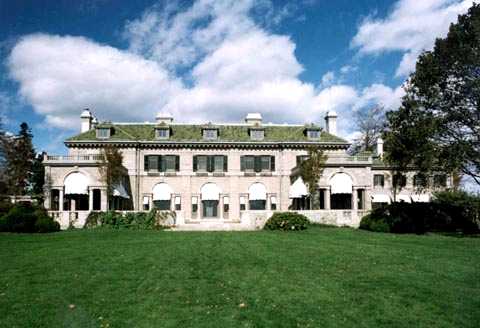
The fact that the Eolia mansion is Renaissance Revival is key, as this architectural style reinforces the mansion, and therefore the park as a whole, as a bastion of opulence, elitism, and luxury. During the Renaissance, European elites viewed and used luxury arts and architecture to maintain and reaffirm preexisting social order.13 Architectural historian, Christy Anderson, uses the term ‘architecture of ascendancy’ to elaborate on the relationship between Renaissance architecture and sociopolitical power. She states that Renaissance architecture is “an active participant in political rule, projecting the identity of those in power and standing in for their physical presence.”14 Later Anderson writes specifically about Renaissance architecture in the natural world, stating that a Renaissance country home, like the Eolia mansion, projects the residing family’s identity and ideals to the outer world.15
Applying Anderson’s analysis to the Eolia mansion, it is evident that the architecture of the Harkness’ mansion reinforces their power and prestige in the area. It makes no difference that the Eolia mansion was the Harkness couple’s summer home. Even when Mr. and Mrs. Harkness were away, the mansion remined locals of the couple’s elite status.
Two of the most iconic features of the Eolia mansion are the East and West Gardens it boasts on both sides. Two landscape architects, Franklin Brett and George D. Hall, conceived the original underlying framework of the gardens, but it was Beatrix Jones Farrand, who oversaw the design and maintenance of the Eolia gardens from 1919 to 1935, who turned the gardens into elite symbols.16
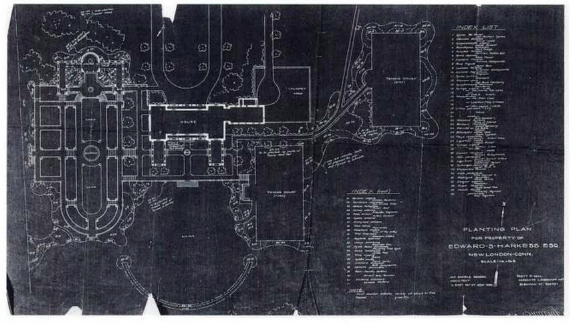
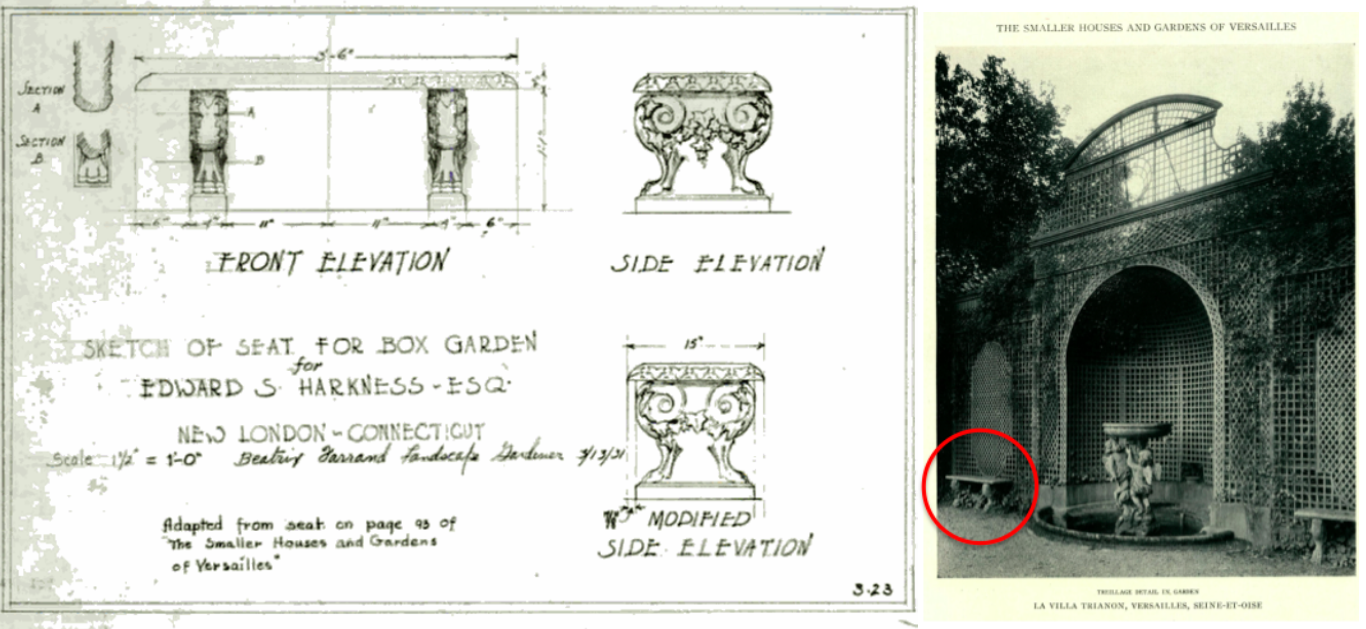
Like the Eolia mansion, the gardens have a strong tie to the Renaissance Revival movement. For example, the image above shows one of Farrand’s original sketches for a garden seat from 1931. In this sketch, Farrand notes that her design for the seat is adapted from a similar seat found in The Smaller Houses and Gardens of Versailles.17 Farrand’s adaptation of traditional Renaissance features reinforces the gardens as symbols of elitism and tools for projecting the Harkness couple’s sociopolitical power to the locals.
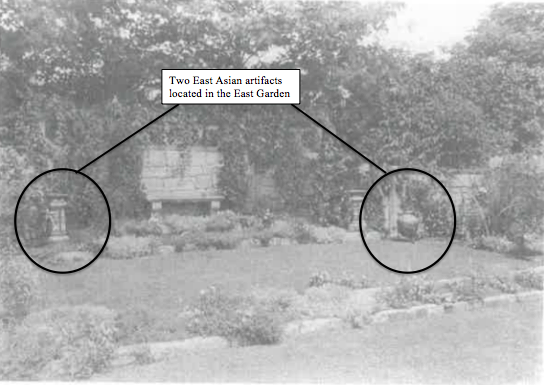
The botanical gardens also contain non-Renaissance Revival features to reinforce the fact that they are spaces intended for the wealthy. For Farrand, the East Garden had a double entendre: it was physically on the east of the house but also was a space she used to evoke the Orient.18 Specifically, Farrand incorporated blue Chinese vases, Korean statues, and two stone Chinese dogs that symbolically guarded the space, into the East Garden. Farrand incorporated East Asian ornaments in other elite, private gardens as well, notably the Rockefeller garden in Seal Harbor, Maine.19 Farrand, however, did not include these artifacts because of genuine interest in the East Asian culture – in fact, she had never travelled to the East. For Farrand, these oriental ornaments represented the exotic, which she smartly used to establish the Eolia garden as a space catering to elite, genteel New Englanders.
The elitism inherently associated with the architecture and design of the mansion and gardens is heightened by the fact that Harkness Park is still a living and performing space that feeds into the traditionally New England ideals of white, affluent homogeneity. The largest source of revenue for Harkness Park comes from renting out the Eolia mansion, primarily for weddings. Renting out the space is expensive, costing $5100 for five hours.20 In 2014 there were over 100 weddings at the Eolia mansion and a total of $364,907 was made from renting out the space. Compare this to $162,355 that was made from parking fees and season passes.21 These values are particularly revealing considering 224,000 people visited the park in 2014, only a small percentage of whom attended weddings and other events at the mansion.22
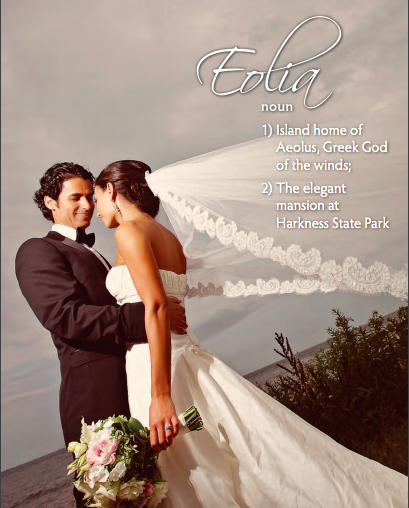
As exemplified by “The Weddings at Harkness” brochure, Harkness Park feeds into the New England ideals of white elitism when advertising the venue. Analysis of the inside cover of the brochure reveals that park managers want to make certain to potential customers that Harkness Park is an elite space, boasting elegant mansions fit for gods. The content within the brochure is a manufactured idealization of Harkness Park, not unlike the fabricated New England tourist industry of the 19th century that commodified the same New England ideals as Harkness Park to entice outsiders to the region.23 The brochure states that “during the cocktail hour, guests languidly stroll through restored historical gardens … and wind their way back to the Mansion where they dine by candlelight.”24 By depicting wedding guests interacting with this space in a way unpermitted by the average park visitor, the brochure presents the park as an elite, quasi-privatized landscape. Additionally, of the 25 pictures containing people in the 24-page brochure, not one depicts a person of color, feeding into the racial purity desired by elites looking to vacation in New England during the 19th century.”25
What is most concerning is that the mansion, and all that it represents, has become the main identity recent park management actively projects to the public. In 1996, the mansion and gardens, but no other aspect of the park, underwent a $3.8 million renovation.26 To be clear, preservation of elite historical buildings itself is not problematic. The fact that the park has spent millions of dollars to preserve a mansion that reinforces white elitism in the current day, without similar efforts into the more “public” parts of the park, however, is. The Eolia mansions and botanical gardens in Harkness Park were, and still are, spaces that only keep genteelly New Englanders in mind, further alienating minority and low SES locals.
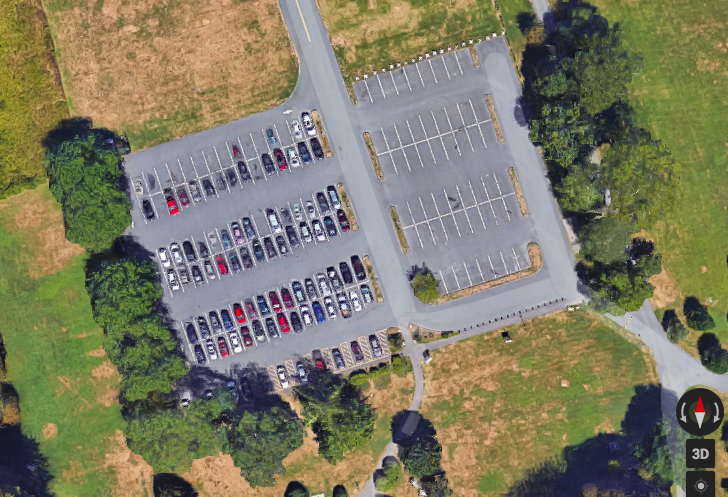
Here, the public picnic tables serve as symbols for the more “public” spaces of Harkness Park used by the non-WASPy visitors. At Harkness Park, there are unwritten social rules that govern how different people interact with the landscape. As shown below, visitors tend to park in the parking lot that is further from the Eolia mansion, even when there is no wedding taking place. Though visitors are technically permitted to park wherever they please, there is an underlying social expectation that that the parking lot closer to the Eolia mansion is only to be used by those who have reason to enter the mansion. Moreover, whenever there is a wedding, it is expected that guests do not stray anywhere near the vicinity of the event, as if the sight of locals would somehow mar the occasion.
Additionally, the park is physically organized in a way that nudges different people to interact in the space differently. The picture below depicts a spatial analysis of the Harkness Park landscape. As shown, the spaces intended for the common people are concentrated near each other. The brown-roof building is the public restroom, which is located in front of the parking lot and adjacent to the only congregation of picnic tables in the park. While this proximity is convenient, the fact that there are no other picnic tables, or other public amenities of any sort, nudges visitors towards the outskirts of the park. The location of these amenities is far from coincidental, as the layout of the walking paths reinforce this positionality. The picture below depicts four different paths. The purple and red paths lead to the Eolia mansion and the blue and yellow paths lead to a mini amphitheater. I selected this amphitheater as a comparison point to the Eolia mansion because it is in many ways, its antithesis. Just like the mansion, the amphitheater is a popular wedding site, but is free of charge for couples that desire a lower budget wedding.
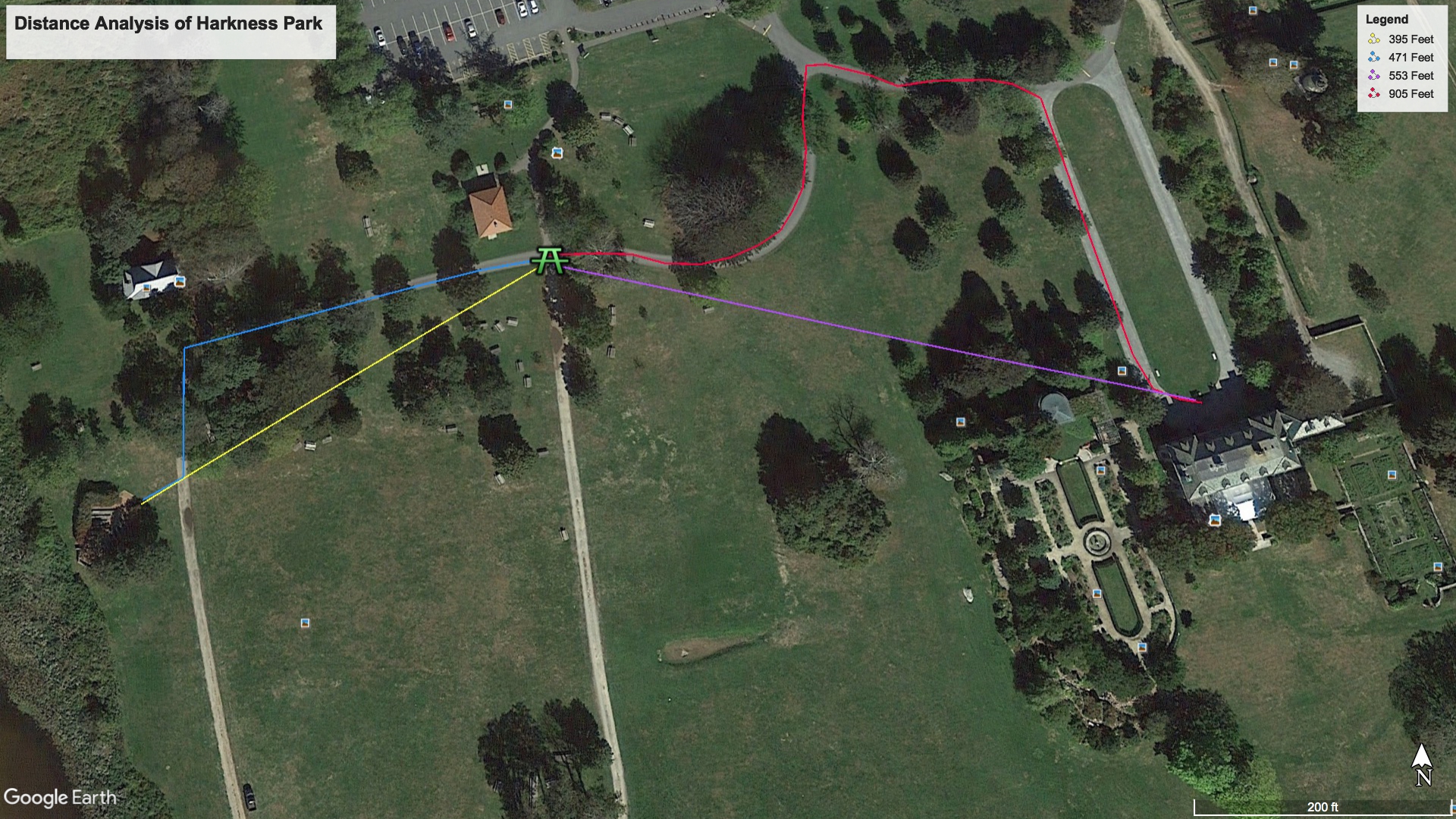
The yellow and purple lines represent the shortest possible distance from the center of the picnic tables to the mini amphitheater and Eolia mansion, respectively. The Eolia mansion is only around 150 feet farther from the picnic tables than the amphitheater. A similar analysis was performed using the constructed paths. As shown by the blue and red lines, the Eolia mansion is now around 430 feet farther from the center of the picnic tables than the amphitheater. The walking paths were designed in a way that made the elite, central Eolia mansion more inaccessible, while nudging common people towards the outskirts of the park.
This is just one of countless examples in which people of different classes interact with space differently. Mona Domosh writes extensively of how class distinctions operated within the Boston Common. She notes how “promenading in the Mall had become the ordinary course taken by the working classes, while the fashionable elite had taken to using the brick sidewalk.”27 While less extreme, the interaction between class and the landscape in Harkness Park and the Common are notably similar.
While there are only 150 feet of Euclidian distance that differentiates the Eolia mansion and the amphitheater from the picnic tables, there are distinct characteristics to the landscape that make them functionally far more distant. As mentioned earlier, the New England WASP identity has been built into the physical and visual landscape at Harkness Park. The common visitor is simultaneously pushed towards the edges of the park while being constantly reminded of the mansion, and all that it represents, in the center. In this way, the values of white elitism are physically and culturally the focal point of the park and are framed as ideals visitors should admire. This is akin to The New York Times take on Central Park who publically stated that the city’s park ought to be less of a true common space and more of a place where members of the lower class should acquire the “refinement and taste and the mental and moral capital of gentlemen.”28
The point here is not that Harkness Park is outwardly racist or segregationist, but that it is an alienating space for many minority and low SES individuals who are governed by unwritten social rules that influence how they interact with the landscape. The location of Harkness Park in a wealthy neighborhood is alienating for these individuals because they are reminded that they have to visit an elite town to visit a landscape that was never intended to include them in the first place. Upon entering the park, they are further alienated by the constant reminders of white elitism that are symbolized by the Eolia mansion, the botanical gardens, and the park’s lucrative wedding industry. Lastly, as exemplified by the design of walking paths, the park is actively designed to reinforce this alienation of nonhegemonic identities.
In the introduction, I stated that Harkness Park catered to the ‘profound sentimentalization’ of the landscape.29 As implied by the body of this paper, it is perhaps this ‘profound sentimentalization’ that makes this analysis of Harkness Park specific to New England. Harkness Park feeds into an image of a wealthy and homogenously white New England that Dona Brown argues has always been a pulling force to attract elites to the region.30 This “sentimental” tourism had a particular physical aesthetic, boasting open fields, farm buildings, and forested hills.31 Residents of New England internalized these pastoral features and now view pastoral landscapes as a component of the ‘authentic’ New England. The Harkness couple fed into these New England tropes by building cow barns, stables, and poultry houses on the estate. However, while the couple showcased genteel farming facilities on the landscape, it was never a serious agricultural space.32 And lastly, Mona Domosh states how the curvilinearity of New England landscapes, including Harkness Park, “stood in sharp contrast to the straight lines and rigid angles of the gridiron, a pastoral counterpoint to the urban environment.”33 While Harkness Park is distinctly New England and serves as the antithesis to the urban environment, its greatest vice is that it is still a space that alienates visitors of nonhegemonic identities, proving that simply sharing the same space does not necessarily result in democratic equality in how that space is used.
Cover Image: Eolia mansion at Harkness Memorial State Park. Image Credit:Joanna Fisher
Shashwat Kala hails from Waterford, CT and is a member of the class of 2018 at Dartmouth College. He is majoring in Environmental Studies and minoring in Spanish.
“Harkness Memorial State Park: History and Restoration.” Department of Energy & Environmental Protection. accessed November 2, 2017. http://www.ct.gov/deep/cwp/view.asp?a=2716&q=325212 ↩
“Harkness History.” Friends of Harkness. last modified 2017. http://www.harkness.org/Harkness_History.html ↩
“Harkness Memorial State Park: Waterford.” Department of Energy & Environmental Protection. last modified September 2017. http://www.ct.gov/deep/cwp/view.asp?a=2716&q=325214&deepNav_GID=1650%20 ↩
Morse, Cheryl E, Allan M Strong, V Ernesto Mendez, Sarah T Lovell, Austin R Troy, and William B Morris. “Performing a New England landscape: Viewing, engaging, and belonging.” Journal of Rural Studies 36 (October 2014): 229. ↩
U.S. Census Bureau. Median Household Income, 2014. Prepared by Social Explorer. (accessed November 2, 2017). ↩
Ibid. ↩
Wachsmuth, David, Daniel Aldana Cohen, Hillary Angelo. “Expand the frontiers of urban sustainability.” Nature 536, no.7617 (23 August): 391-393. ↩
Domosh, Mona. Invented cities: the creation of landscape in nineteenth-century New York and Boston. New Haven: Yale University Press, 1996.127-154. ↩
“New London.” ConnecticutHistory.org. accessed November 2, 2017. https://connecticuthistory.org/towns-page/new-london/ ↩
“Harkness History.” ↩
“2017 State Parks and Forests Fees.” Department of Energy & Environmental Protection. accessed November 2, 2017. http://www.ct.gov/deep/cwp/view.asp?a=2716&q=325082&deepNav_GID=1650 ↩
“Harkness Memorial State Park: History and Restoration.” ↩
Belozerskaya, Marina. Luxury Arts of the Renaissance Los Angeles: Getty Publications, 2004. ↩
Anderson, Christy. Renaissance Architecture Oxford: Oxford University Press, 2013. 87. ↩
Ibid., 178. ↩
Emmet, Alan. “Mr and Mrs Harkness’s Eolia: Beatrix Farrand’s Work with an Existing Plan.” The Garden History Society 13, no. 1 (Spring 1985): 45-59. ↩
McGuire, Diane Kostial. Beatrix Jones Farrand (1872-1959): Fifty Years of American Landscape Washington D.C.: Dumbarton Oaks Colloquium on the History of Landscape Architecture, 1982. ↩
Emmet, 51-53. ↩
Ibid. ↩
“Eolia - The Mansion at Harkness Memorial State Park.” Department of Energy & Environmental Protection. accessed November 2, 2017. http://www.ct.gov/deep/cwp/view.asp?q=325196 ↩
Office of the Commissioner. “Budget and Expense Report of Harkness Memorial State Park FY 2013-2017.” Department of Energy & Environment accessed November 7, 2017. ↩
Darin, Mark. “2014 - Park Supervisor’s Year End Report.” Eolian. December 8, 2014. ↩
Brown, Dona. Inventing New England: regional tourism in the nineteenth century. Washington: Smithsonian Institution Press, 1995. 132. ↩
“Eolia: The Mansion at Harkness Memorial State Park.” Department of Energy & Environment. accessed November 2, 2017. ↩
Brown. ↩
“Harkness Memorial State Park: History and Restoration.” ↩
Domosh, 144. ↩
Rosenzweig, Roy, Blackmar, Elizabeth. The Park and the People: A History of Central Park. Ithaca: Cornell University Press, 1992. ↩
Morse. ↩
Brown. ↩
Morse, 227. ↩
Emmet, Alan. So Fine a Prospect: Historic New England Gardens. Hanover: University Press, 1996. ↩
Domosh. ↩