Today, across America and even internationally, the town of Woodstock is esteemed as “the essence of small-town Vermont.” 1 Ever since the great philanthropist and environmentalist Laurance Rockefeller selected Woodstock in the 1960s as his pet project—both as a site for upscale resort development and as a place of new-age conservation—the town has been in high demand as a tourist destination and vacation getaway. Yet, there is no doubt that this tourist appeal, at least on a more regional level, has been meticulously cultivated since long before the Rockefellers came to town; indeed, since the turn of the 20th century, various parties have striven to frame Woodstock as an authentic Vermont town with a storied history, a place where one can relax and recreate all four seasons of the year. Significantly, even today—long after the enormous development project by RockResorts in 1968 that ostensibly changed Woodstock forever—the town still clings to and profits from a reputation of being unchanged by time.
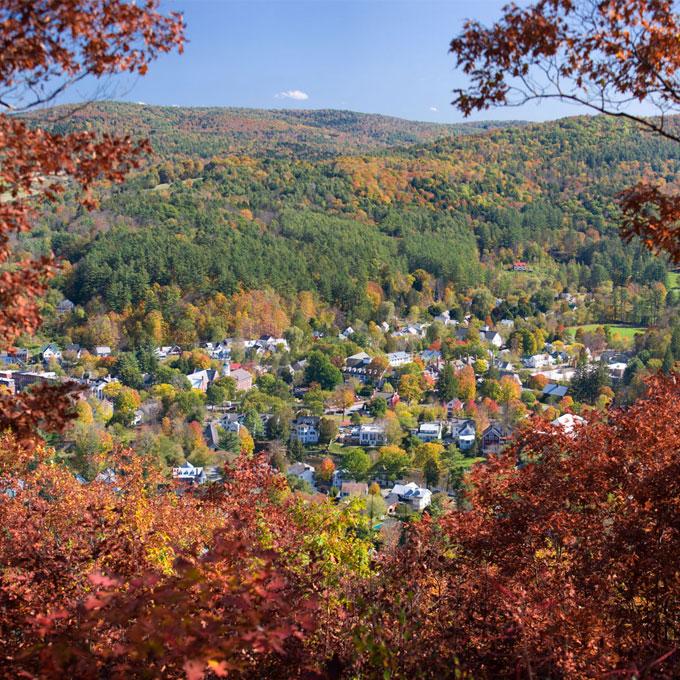
My central question for this project is inspired by an elegiac memoir, Bruce Coffin’s The Long Light of Those Days: Recollections of a Vermont Village at Mid-Century, that describes the experience of growing up in Woodstock in the ‘old days’—before the Rockefellers, the 5-star luxury resort, the Billings Farm Museum, and the attention in the Los Angeles Times. The question then becomes: is there such thing as an ‘old’ and ‘new’ Woodstock? In trying to reach an answer to this question, I use the development of the Woodstock Inn—from its 1790s birth as the Richardson Tavern to the reconstruction by RockResorts in 1968—as a lens through which to track broader changes in the landscape and fabric of the town of Woodstock. In doing so, I will test the validity of Coffin’s notion of
“these two Woodstock, the town full of strangers…and the old, familiar town that maintained itself in the memories of a dwindling number of long-time residents…where houses were largely homes and not real-estate investments, and where the commercial buildings were seen as places for stores serving the basic need of the community and its outlying farming districts rather than the so many square feet of retail space for profiting from the consumer demands of transients and tourists.”2
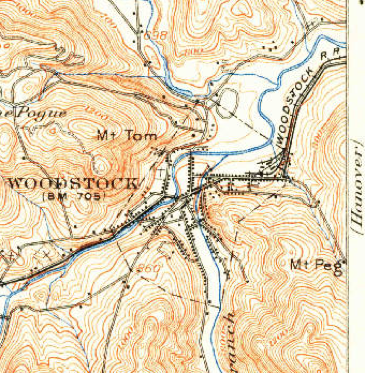
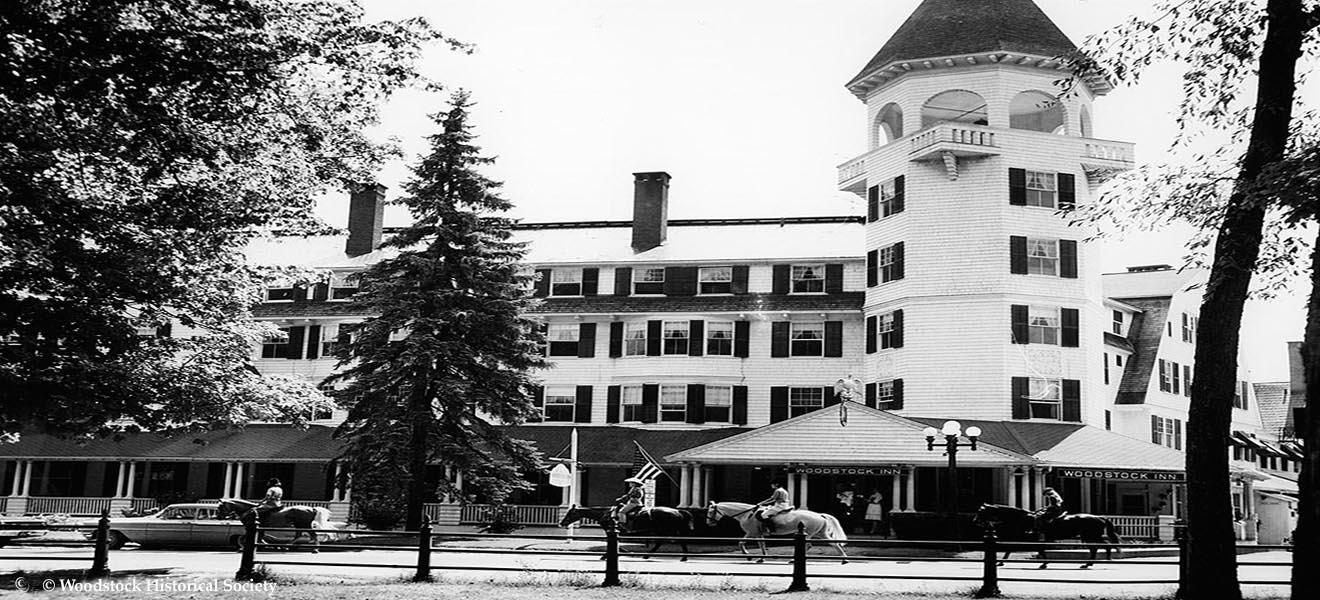
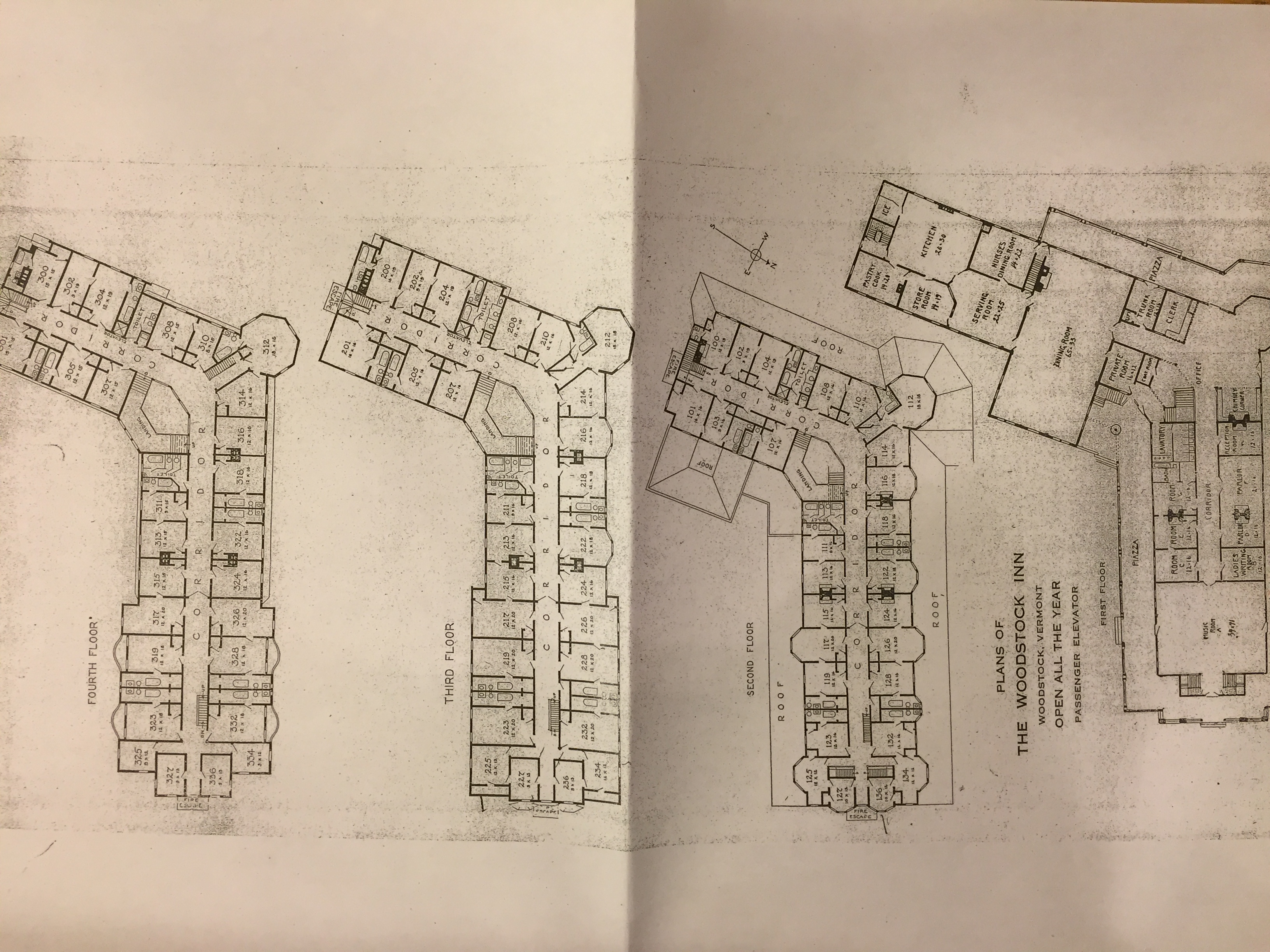
The focal point of this project is that pivotal intervention by Laurance Rockefeller to buy and reconstruct the Inn in 1968; however, I will first explore the early imaginative processes that took place to establish Woodstock as a destination for an ‘authentic’ New England vacation. The subject of this study will be the old Woodstock Inn, first established in 1892. I will explore the role that Inn manager Arthur Wilder played in shaping the inn as a destination for regional tourism and recreational skiing, and the effects of Rockefeller’s aquisition of the small-town ski area, Suicide Six. Then, I will examine the gentrifying effects that followed when Rockefeller subsequently acquired and rebuilt the Inn itself, as well as the ways the new Inn balanced this development by reproducing and memorializing its past traditions. Finally, I will move to the Marsh-Billings farm, a working farm that Rockefeller turned into a museum and national park conservation project, as an example of the care that Rockefeller took to create an image of a town unchanged by time. Ultimately, I will conclude that there were many changes to the town that came with development and that distinguished Woodstock post-1969 from its former self; however, they were well-concealed by twin forces of cultural preservation and environmental conservation that came with ‘Rockefellian’ development and that were themselves reminiscent of various types of cultivation that had always played a role in shaping picturesque Shire Town of Windsor County.
When the original Woodstock Inn opened in 1892, it became “Vermont’s first winter-sports center for tourists, and for two decades its rioutous winter parties were the talk of Boston and Montreal sportsmen.”3 For these early sporty vistors, activities included “snowshoeing, skating, sleighing, and tobaganning. 3
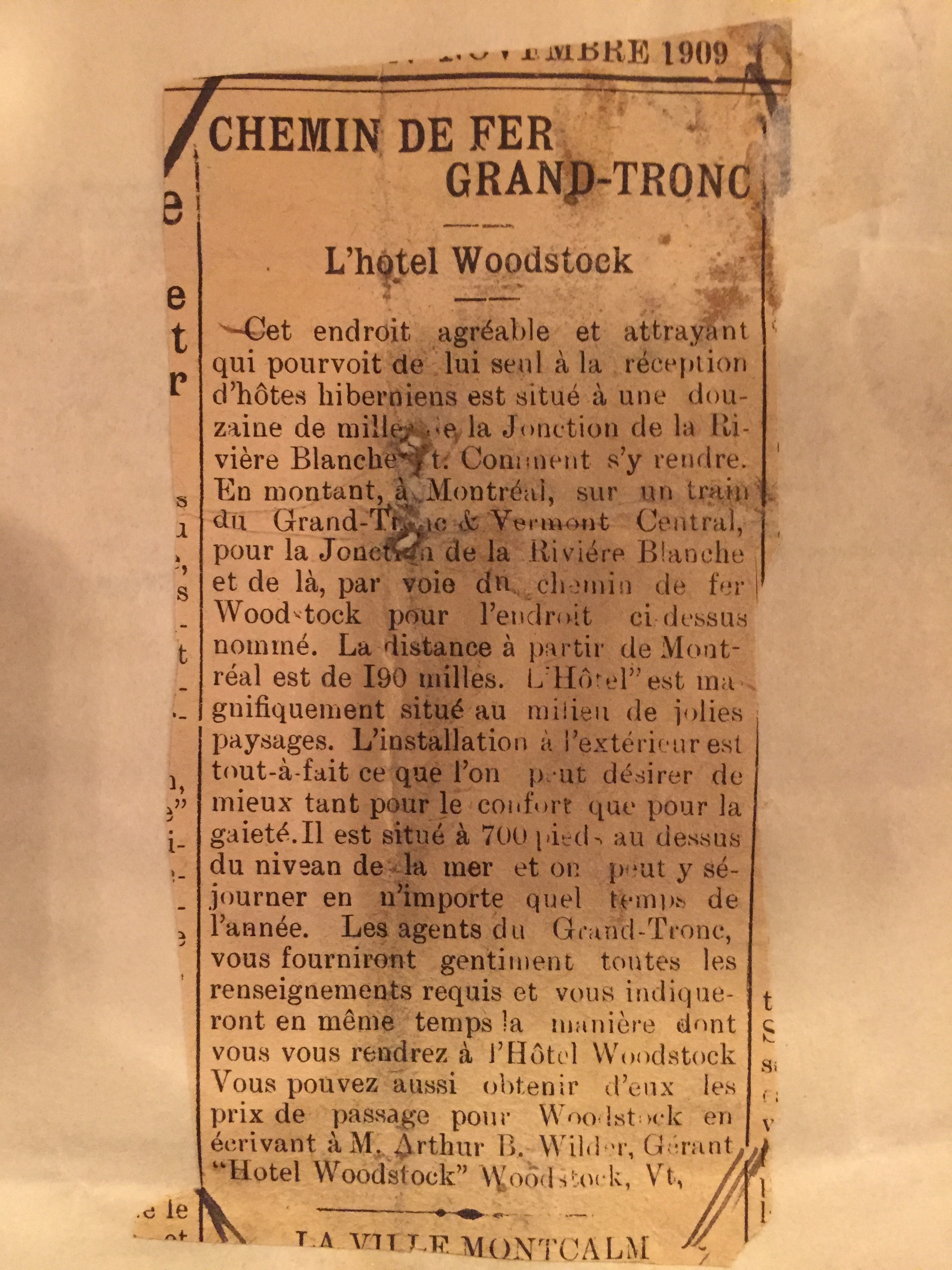
These visitors were mostly involved with private athletic clubs and there was no definitive Woodstock ski destination for the commoner at this time; in short, Woodstock had yet to be populized as a definitive ski town. In fact,it was Inn Manager Arthur Wilder who is largely credited with advertising Woodstock’s recreational appeal and campaigning for Woodstock as a ski town in the winter and a golf town in the summer.4
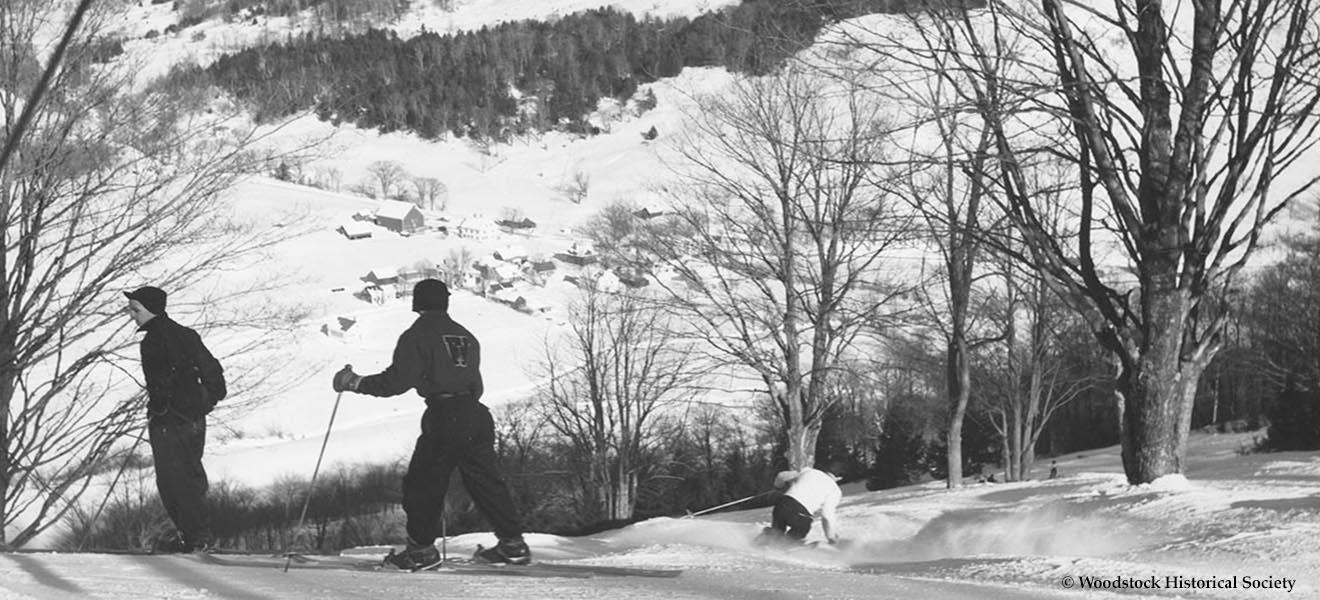
Even still, Woodstock’s ski tourism did not truly take off until Wallace “Bunny” Bertram bought a small property north of Woodstock named “Hill Number Six.”[5] Bertram, a former captain of the Dartmouth Skiing team, renamed the hill Suicide Six Ski Area, and it was in the years following “Woodstock entrepreneurs and winter enthusiasts threw their energies into marketing the burgeoning industry.”5 Since then, others have dubbed Woodstock, VT–which claims to have built the nation’s first ski town in 1934–as the “Cradle of Winter Sports.” 6 Finally, in 1961–seven years before Laurance Rockefeller would completely renovate the Woodstock Inn– Rockefeller bought Suicide Six and its ‘sister’ ski area, Mt. Tom. Rockefeller installed a snowmaking system at Suicide Six and a new Poma chairlift at Mt. Tom 7
According to the Vermont Standard, “the thought of an outsider coming in to take over two small, local family ski areas did not sit well with many of the regulars. Waves of local resentment reverberated…locals saw no reason to ‘restore’ Woodstock–they thought it was fine just the way it was–although the creeping gentrification, both in town and at the ski areas, was hard to ingore.” [6]
This resentment would certainly resonate with with the aforementioned local Bruce Coffin and others intimately familiar with the small-town, family-like tradition of skiing in Woodstock; however ,for outsiders looking in, Woodstock managed to maintain a sense of timelessness throughout this process. Said one outsider, ““Woodstock is the village which probably more than any other in Vermont has reverently preserved both the physical setting and the spiritual flavor of an earlier day. Long one of the favorite summer resorts in the State and recently a center of winter sports development, Woodstock has nevertheless retained the somewhat astringent quality of its native personality.” 8 And another: “In the town ofWoodstock, where organized downhill skiing had developed in the early 1930s, winter tourism seemed to have had little impact on the town.”9
These findings seem to resonate with a recent study on “place attachment” by Walker and Ryan, titled “Place Attachment and Landscape Preservation in Rural Maine: A Case Study.” In surveying residents of Monmouth, ME, the authors discovered two findings pertinent to our discussion of Woodstock. First, Walker and Ryan found that relatively shorter-term residents perceived the landscape as less changed relative to longer-term residents. This could explain why visitors and tourists–perhaps an extreme example of a “short-term” resident–might view Woodstock as unchanged.[^10] Second–and more specifcally relevant to these perceptions regarding the Rockefeller’s acquisition of Suicide Six–the authors found that long-term residents felt stronger about “cultural elements” of the town than did short-term residents.[^10] Perhaps the study explains truths which some might consider self-evident; nevertheless, these authors give us empirical evidence to explain why locals might experience a particular attachment to a place like Suicide Six as compared to interlopers, and specifically how Rockefeller’s acquisition and refurbishment of a site like Suicide Six might contribute to a delineation of an ‘old’ and ‘new’ Woodstock for locals given their keen eye for change and close attachment to cultural elements.
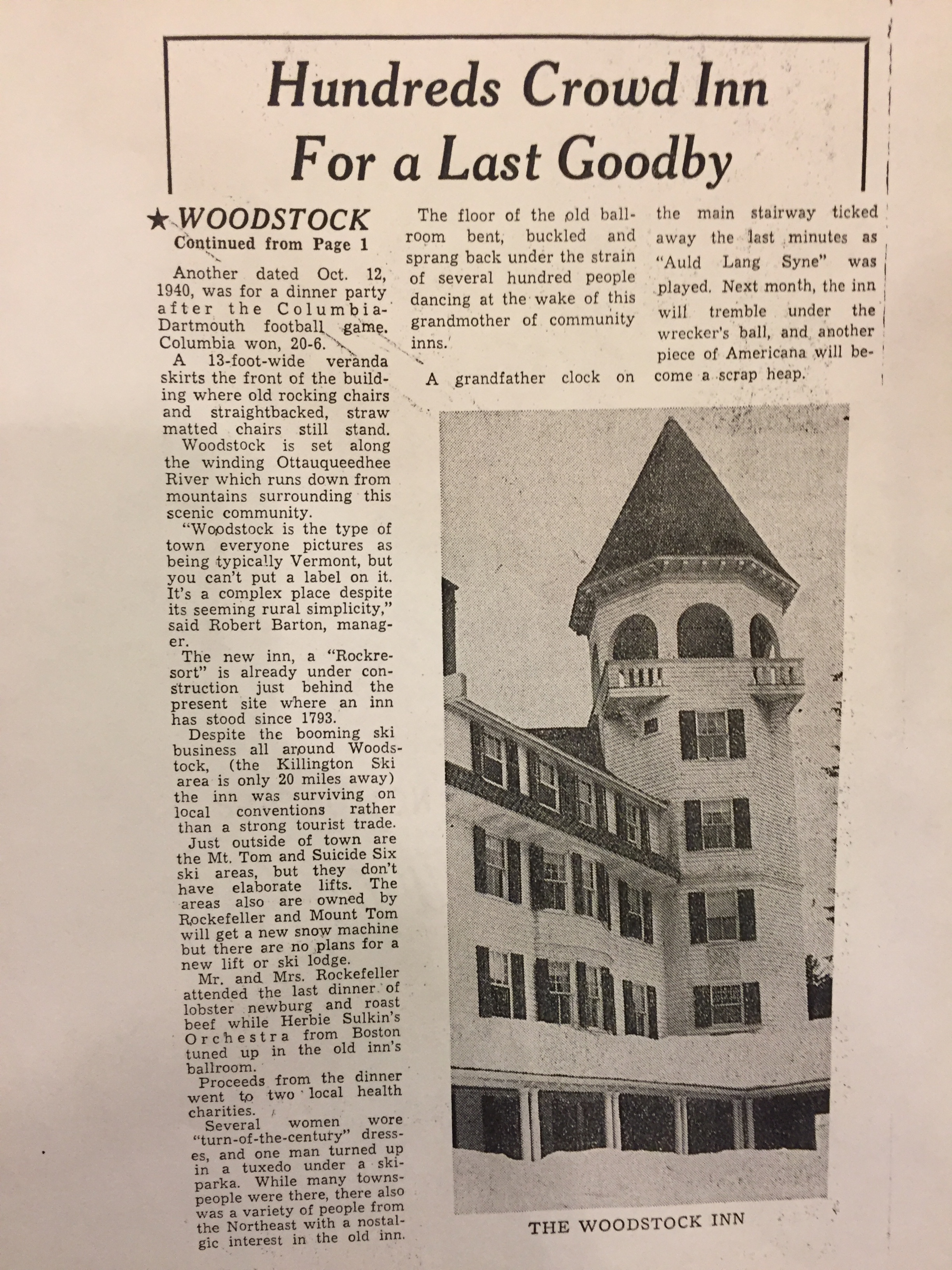
When Rockefeller purchased the Inn seven years later 1968 and made public his plans to raze the old building, the prospects of development were met with mixed reviews. One newspaper clipping, which I found in the archives of the Woodstock Historical Society but was unable to source or date, described a goodbye party for the old inn, which presumably took place in late spring of 1968. The article, titled “Hundreds Crowd Inn for a Last Goodbye,” lamented that the RockResorts redevelopment meant that “another piece of Americana [would] become a scrap heap.” 10 The article also expressed the fact that “the inn [had been] surviving on local conventions” despite the rise of the recent boom in regional tourism.” 10 Inn Manager Robert Barton is quoted and puts his finger on the complex relationship that Woodstock has with the pastoral Vermont imaginary: “Woodstock is the type of town everyone pictures as being typically Vermont, but you can’t put a label on it. It’s a complex place despite it’s seeming rural simplicity.” 10
The fact that Barton remarks upon the complexity of Woodstock’s identity at such a transitional moment for the town seems signifcant; indeed, others around the same time expressed their uncertainty about the upcoming redevelopment. An editorial in the Vermont Standard titled “Woodstock’s Future” describes a “growing uneasiness about Woodstock’s future,” a feeling which the article remarks as having “been smoldering for some time–but probably reached its climax last week when the demolition of the venerable old Woodstock Inn began.” 11 The article goes on to mention the “sober thought to many of us how long the average working man can afford to live in Woodstock.” 11 Most of all, the residents of Woodstock–in the spring of this pivotal year for the town–seem frustrated at a seeming lack of planning dedicated to the working man. The board goes on to urge action: “We think it is high time that the working man who is trying to raise and educate a family on an income of $5,000 to $6,000 a year is given more consideration in our planning–and something done before it is too late.” [12]

The working man’s fears of gentrification proved to be well-founded; indeed, in the next few years, rents and housing prices soared in the town. According to a 1973 article–written by Woodstock native and Balitmore Sun journalist Linda Dunn–that appeared in the Vermont Times, “Woodstock, with Rockefeller at its backbone, [was] fast becoming a tourist mecca.”[13] The article cited a number of telling statistics gathered from the Woodstock Chamber of Commerce. In the previous year, the chamber cited a 45% increase in visitors who registered at the Woodstock green, despite a 13% decrease in tourism throughout the state. 12 The author goes on to describe the effects that this boost in tourism has had on the local economy: “The ‘local’ stores for the farmer and the native such as discount dry goods store and an inexpensive men’s clothing store have moved away, making room for a wine and cheese store, a gourmet delicatessen, and a shopping center with a fancy boutique and other luxury stores.”12
Dunn goes on to cite the Chamber of Commerce’s president, Mike Pearce, who noted at the time that 8-10 businesses had moved into Woodstock in the past year and that the asking price for one store in the heart of the village jumped from $54,000 to $89,000 in one year.12 Dunn also notes that the “skyrocketing land values and land assessments … have locked out the farmer and the poorer family who can no longer meet rising costs.”12 The golf dues at the Woodstock Country Club rose from $65 to $265 the year that the new resort was built, “bringing the price to a level where locals can no longer afford to play.” 12
In addition to Dunn’s insight in the Vermont Times, the Worcester Telgram and Gazette–which undoubtedly serviced many seasonal visitors to Woodstock–noted similiar changes that had occured in Woodstock by 1976. The article, titled “Sometimes There Are No Rooms to be Had at Woodstock, Vt., Inn,” referred to the opening of several shops and restaurants in the prior few months, including Bentley’s Restaurant and Green Mountain craft shop.13 The article goes on to say that “almost without exception, you will find a non-Vermonter behind each new business.” Highly poigant to our previous discussion of “place attachment” and the differences between long-term and short-term residents in recognizing change in a place, the article states that interviews with the new shop-owners revealed that they “want to keep Woodstock just like it is.” The irony is overt - the new residents, who come from afar to open up a new shop and thereby directly change the landscape of the town, nevertheless quickly assert their recognition of a certain ‘timelessness’ of Woodstock. Frank Teagle–another employee of the Woodstock Chamber of Commerce–notes further about the change: “Ten years or so ago, it was the old-timers who ran the shops around the square. Now I can think of only one old-timer who runs a shop … most of the businesses that have changed hands are owned by people from out-of-state.”13
Thus, the new Inn clearly caused significant gentrification in the town of Woodstock. When I reached out to Bruce Coffin via phone for an interview, he described this effect. He recollected the following feeling upon returning to the town late last summer and tkaing a walk around the green: “By the time I got back to the car, for the first time ever, I got in the car and I got the hell out of there and headed to White River. And once I got to White River I felt at home because there was the presence, the obvious presence, of working-class people … you know, everything had been gentrified.”14 Obviously, there has been a complex combination of forces and trends that have caused this effect over time. But the turning point seems to have been the reconstruction of the Inn in 1968 - it breathed luxury, attracted wealthy tourists, and left the town different for it.
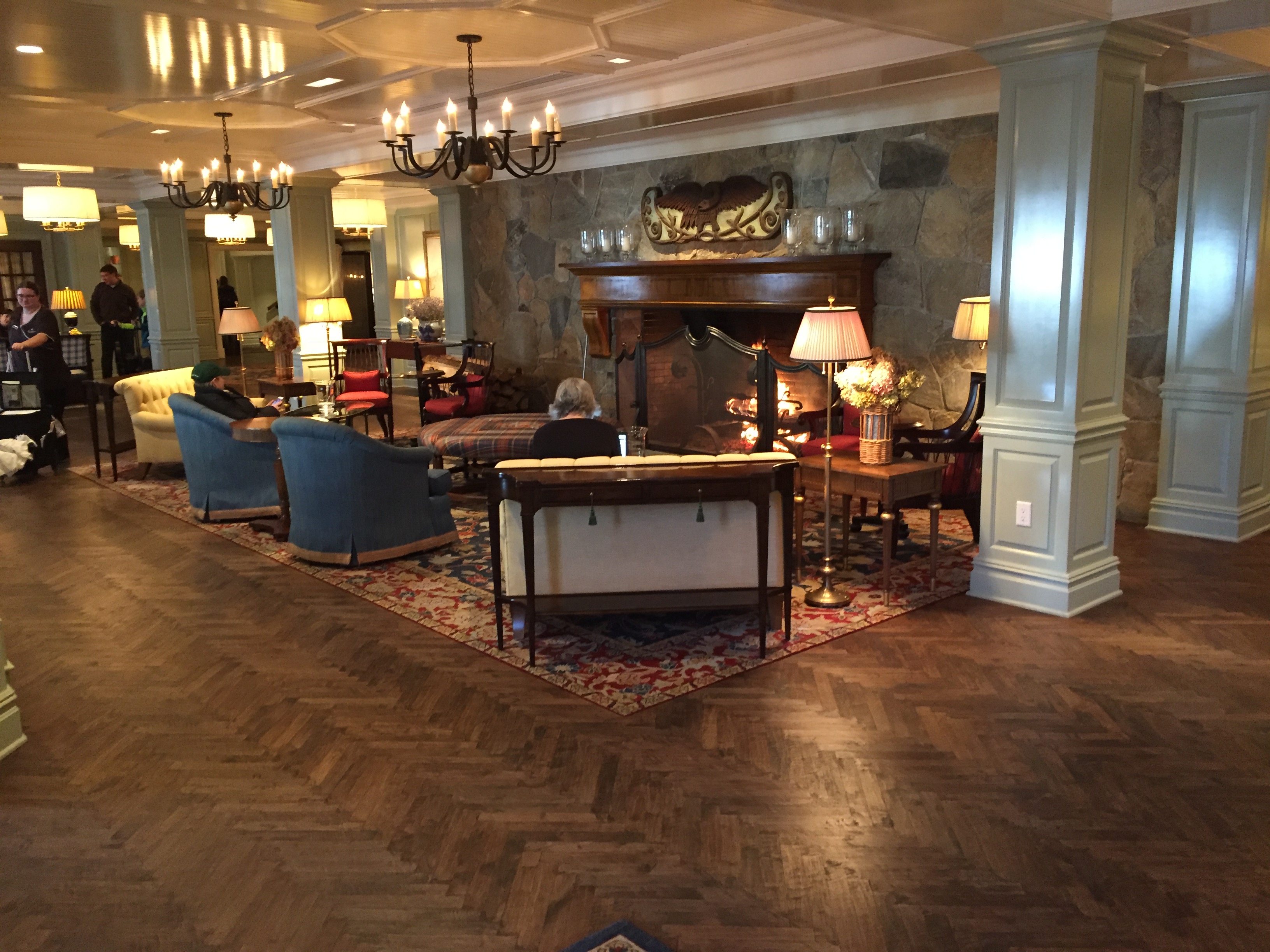
But the story seems not to end there. For, after a field trip to the new Woodstock Inn, I quickly learned that the new building is a living memorial of the old. The new Inn, despite being the embodiment and driving force of change and development in Woodstock, reveals a distinct cultural preservation intrinsic to the town.
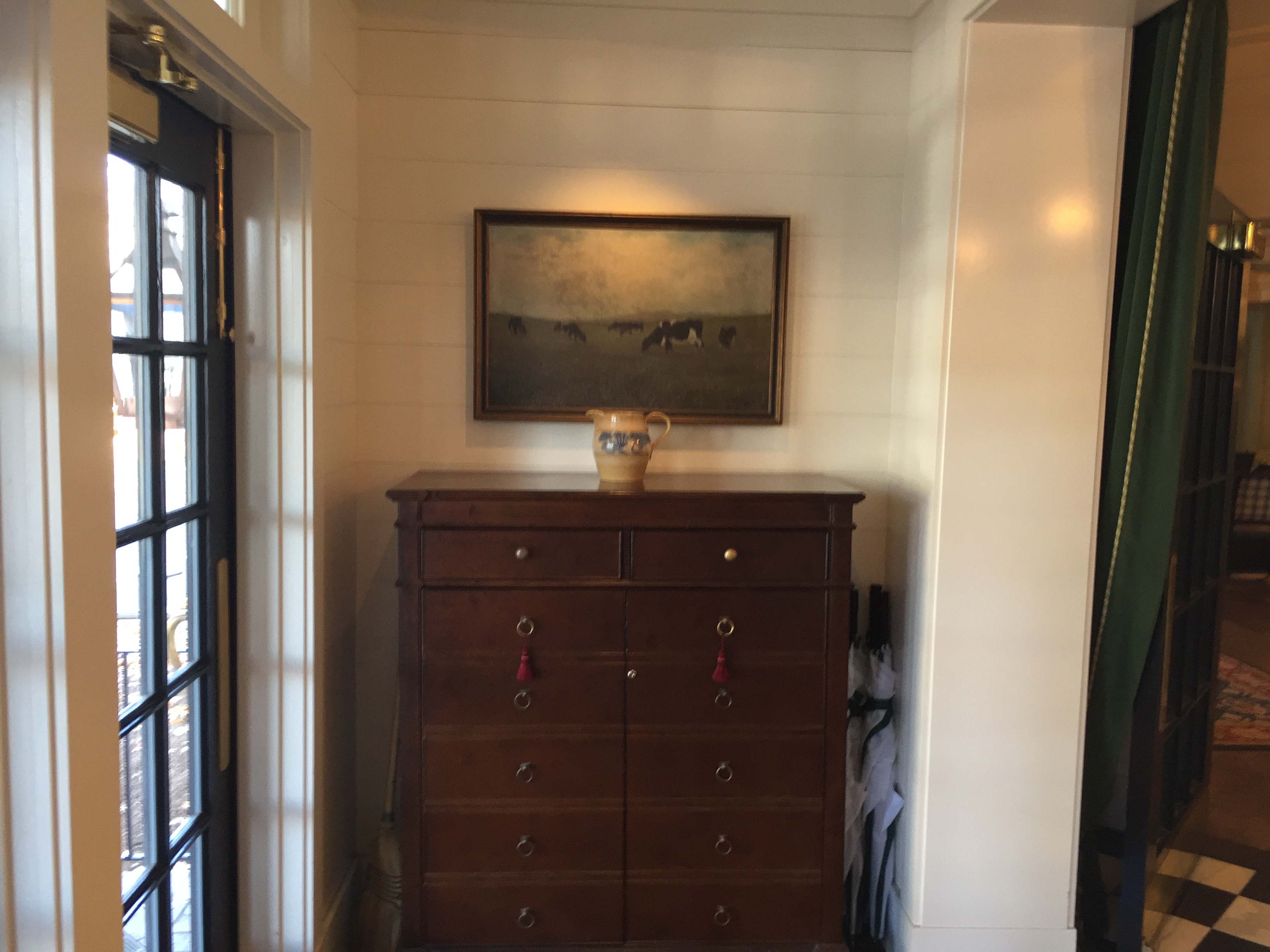
One need only look at the paintings that adorn the walls of the new Inn. Directly to the left of the doorman hangs an Arthur Wilder original - a peaceful scene of a cow pasture. 30 yards ahead and to the left, one heads down a staircase towards the ‘Wilder Room.’ On the staircase hangs a brief bipography of Wilder, a potrait of Widler, and another of his pastural paintings.
Wilder’s influence remains strongly imbedded in the ethos of the place, and the designers of the new inn made a deliberate decision to tell his story - indicating that they believed that this new building was a continuum of the work he started back in the early 20th century.
In another hallway, one finds a painting of the orginal 1892 Woodstock Inn - four stories with bell tower in front. Again, this suggests that the desginers of the new Inn see the 1969 reconstruction as a renewal project - not the ‘raze’ of which Coffin and contemporary newspaper cliippings spoke.
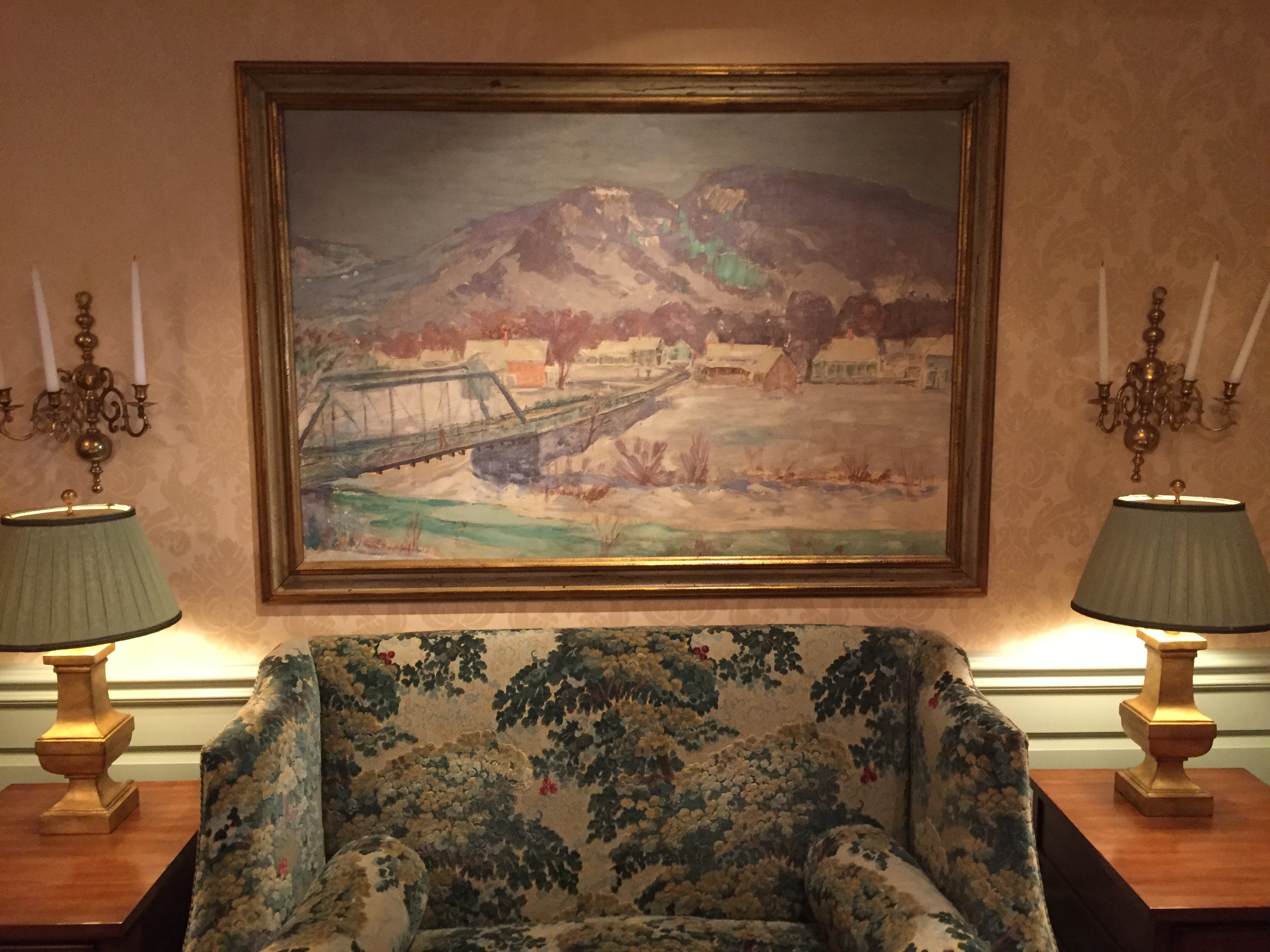
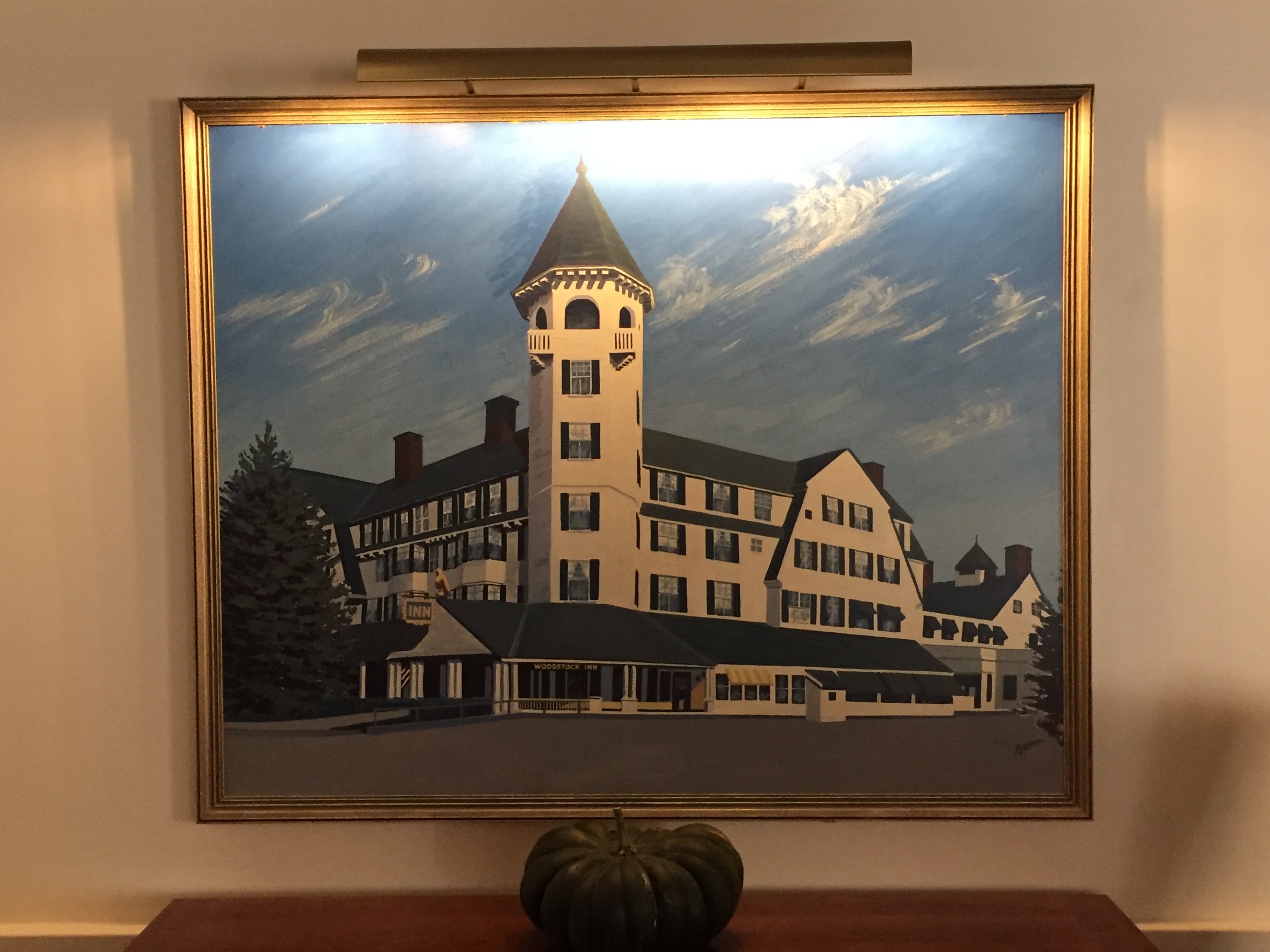
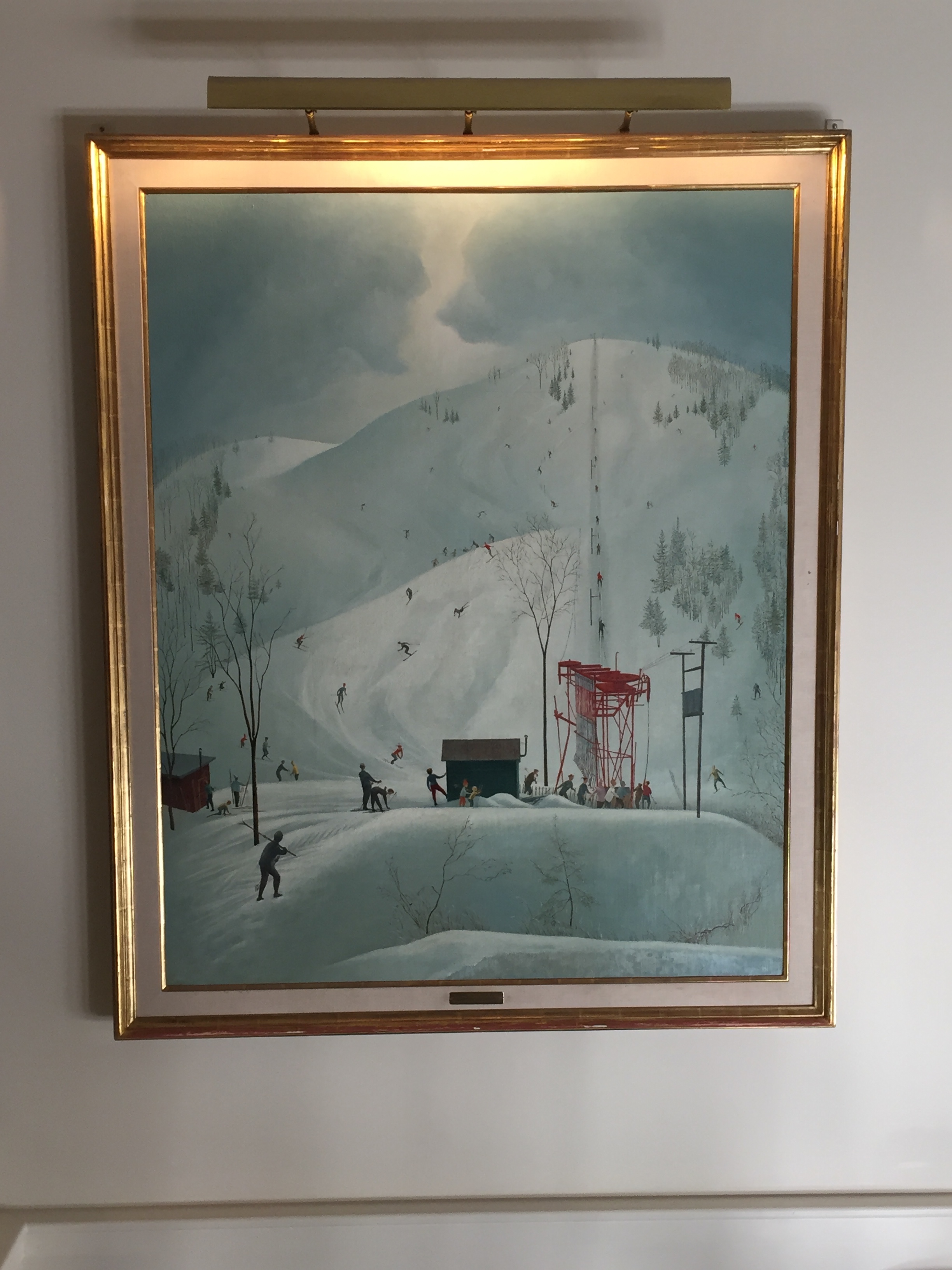
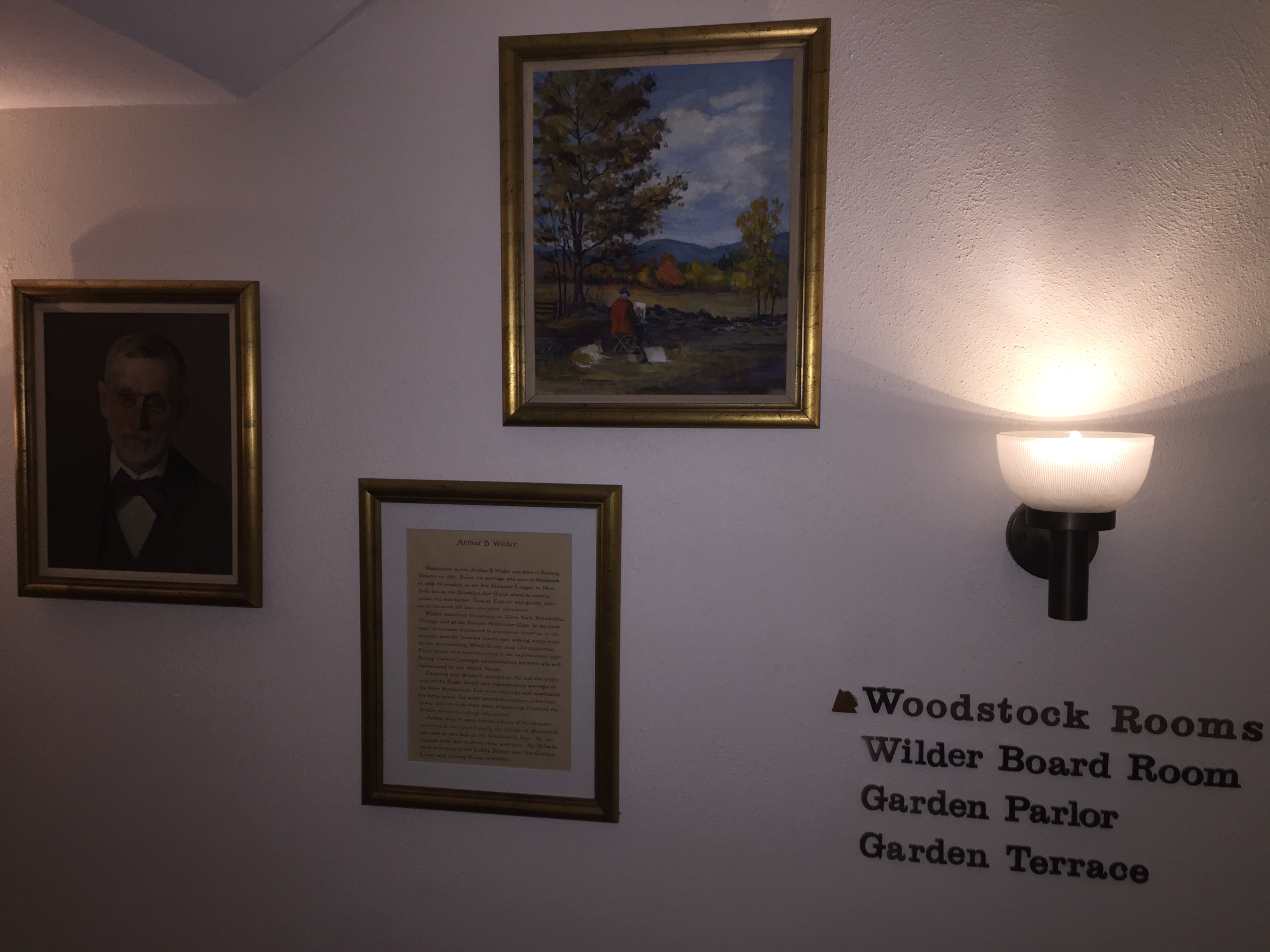
These paintings are are not mere decorations. They are what Conforti might call a body of “culutral work” that was designed in 1968 to “affirm the people, folkways, and pastoral beauty” of Woodstock and package it for tourist consumption.15
Thus, the new Inn represents both the old and the new - and perhaps serves as a microcosm of the local ambivalence regarding the two. As an economic machine, the new Woodstock Inn and Resort seeks to profit from not only the reputation of its first class amenities, but also from a reputation that pegs it as historic, traditional, small-town New England lodging.
The final aspect of this tension between the ‘old’ and ‘new’ Woodstock can be pinpointed in the conservation projects that Rockefeller launched during the years in which he was buying up properties in Woodstock and reconstructing the Inn. The conseration projects include the creation of the Billings Farm & Museum (an exhibit of a working, classic Vermont farm, open to public admission at cost and located to the north of the town) on the estate of Rockefeller’s wife Mary French.
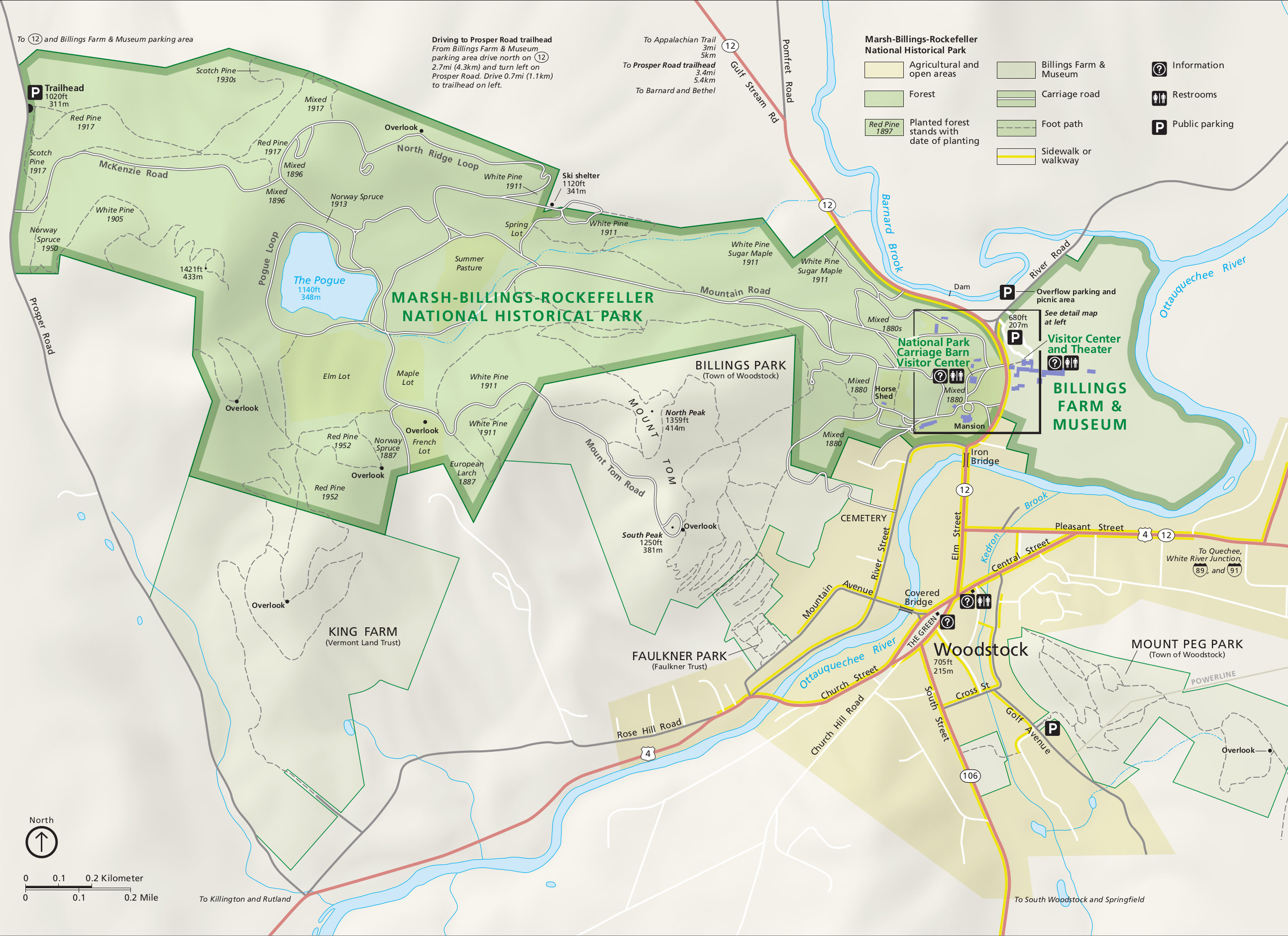
Additionally, Rockefeller pushed for the creation of the Marsh - Billings - Rockefeller National Historic Park, which lies directly across the road from the farm and also includes trail heads south of the town.
According to those familiar with the story, “Laurance Rockefeller said that his interest in Woodstock flowed simply from the fact that it was Mary’s home – his active participation in the shaping of Woodstock’s future grew as a natural consequence of their shared interests and their love of the outdoors.” 16
But just like a closer look at the Woodstock Inn reveals how its furnishings strategically historicize the past, the implications of Rockefeller’s conservation projects deserve a closer look as well. Bill Wood - former president of the Woodstock Chamber of Commerce - said to Linda Dunn back in 1973,”tourism depends upon the picturesque, and Rockefeller’s in the business to make money.” 12
Rockefeller did not just buy the Inn - he bought most of the land surrounding Woodstock. It was a pattern of land development - or conservation - that was mostly lauded. But it was also a pattern of land settlement that virtually gave him power over all of Woodstock. By balancing development with conservation, Rockefeller blurred the lines betweent the old and the new Woodstock. By the time people realized that the old Woodstock was gone, it was too late.
As Dunn says regarding Rockefeller, “Businessman, environmentalist, and town resident, he will create a highly successful tourist business. His investments will stimulate cafrefully controlled economic boom which will never threaten the peace of his own house and which will be tailored to meet the most stringent environmentalist demands - for underground lighting, proper sewage disposal, or authentic restoration procedures … he is by virtue of his activities a feudal lord in a feudal town. At the same time, by virtue of his other obligations, in New York and in the nation, he will come and go, always a tourist in the tourist town he has created in his own image.”12
Perhaps Bruce Coffin’s sentimental odes to a long-gone ‘old’ Woodstock are dramatic. As he said himself in my interview with him, the landscape of the town is in many ways much the same as it once was. But the people are different. The economy is different. And most of all, the power structure is different. As Dunn says, “The truth is the Woodstock of the past 50 years [meaning before Rockefeller] … was an unusual phenomenon. The town was uniquely democratic despite its wealth. But progress in Vermont is a well-known story. The old couldn’t have lasted and didn’t.” 12
My research of Woodstock revealed less about what actually delineates the ‘old’ from the ‘new’ and more about who cares about the delineation. Locals like Bruce Coffin cared and lamented the loss of a time they might characterize as a golden age. Rockefeller and his wife Mary French cared and sought to profit from the preservation and conservation of the old - and, depending on who you ask - sought to share these economic, environmental, and culural successes with the people of Woodstock. Shopkeepers cared because they recognized that the ‘new’ presented a wealth of previously unknown economic opportunities.
In the end, it seems as if the ‘old’ Woodstock is not truly gone, but somewhat buried - and instrinsically tied to a story that is perhaps best told from a perspective that holds the crucial property of the Woodstock Inn at its epicenter.
About the author:
Joe Balaban is a history major and geography minor in the class of 2019 at Dartmouth College. He grew up in Washington, D.C., and vacationed in Woodstock throughout his childhood.
Carlton, Michael. “Woodstock is the Essence of Small-Town Vermont.” Los Angeles Times, August 31, 1986. ↩
Coffin, Bruce. 2005. The long light of those days: recollections of a Vermont village at mid-century. Woodstock, Vt: Woodstock Historical Society. ↩
Lee, W. Storrs. 1955. The Green Mountains of Vermont. New York: Holt. ↩ ↩
Bousquet, Paul “Woodstock’s Role as a Ski Destination Started Long Before the First Ski Tow,” Vermont Standard, 2010. ↩
White, Heidi “A Hilled Called Six Ushers Local Skiing Into Modern Times,” Vermont Standard, 2010. ↩
Robinson, Jonathan. “Rockefeller Buys Mt. Tom, Suicide Six, Ushering In Resort Era,” Vermont Standard, 2010. ↩
Blake Harrison, “The Technological Turn: Skiing and Landscape Change in Vermont, 1930-1970,” Vermont History. ↩
Federal Writers Project, Vermont: A Guide to the Green Mountain State (Boston: Houghton Mifflin, 1937), 151–152. ↩
Harrison, Blake. “Tracks across Vermont: Vermont Life and the Landscape of Downhill Skiing, 1946-1970.” Journal of Sport History, 262. ↩
“Hundreds Crowd Inn for Last Goodbye,” Unknown author, Unknown publication/date. Courtesy of Woodstock Historical Society. ↩ ↩ ↩
“Woodstock’s Future.” Editorial board of the Vermont Standard, April, 1968. Courtesy of Woodstock Historical Society. ↩ ↩
Dunn, Linda. “Woodstock and Rockefeller.” The Vermont Times. June, 1973. Courtesy of Woodstock Historical Society. ↩ ↩ ↩ ↩ ↩ ↩ ↩ ↩
Zook, Nicholas. “Sometimes There Are No Rooms To Be Had at Woodstock, Vt., Inn.” Worcester Sunday Telegram.” 1976. ↩ ↩
Phone interveiw with Bruce Coffin, November 9th, 2017. ↩
Conforti, Joseph A., “The North Country and Regional Identity: From Robert Frost to the Rise of Tankee Magazine,” in Imagining New England: Explorations of Regional Identity from the Pilgrims to the Mid-Twentieth Century (Chapel Hill: University of North Carolina Press, 2001), 263-309. ↩
“Mary and Laurance Rockefellers’ Billings Farm and the Farm & Museum.” Vermont Standard. 2010 ↩