Along the streets of Old Deerfield, Massachusetts sits Historic Deerfield Inc., an experiential museum aimed at portraying and delivering an authentic New England experience. Upon entrance, a visitor has the ability to tour the renovated historic homes replete with period furnishings or engage in colonial-era activities from open hearth cooking tutorials to silversmithing demonstrations. This place project will examine the roles the museum plays, and how it is both responsible for and responding to New England stereotypes and myths. Visual and textual analysis of marketing materials provided by the museum will form the basis of this evaluation.
Principally, Historic Deerfield operates as a cultural and educational institution, and as a result is a powerful tool in propagating stereotypes and myths of New England. Indeed, people visit the museum to learn about and experience the region and its history. The vast majority of patrons have not taken this course or one similar, and are therefore at the will of the museum when it comes to confirming or denying commonly held New England stereotypes. In this role, Historic Deerfield Inc. portrays New England as a monolithic region defined by its age and history and characterized by a unique mixture of wealth and taste.
To most effectively proliferate this message, the museum necessitates a suspension of disbelief from the patrons, which Historic Deerfield achieves through an emphasis on “authenticity.” Indeed, the logo and motto of the museum serve as principal evidence.
The key acts as a visual symbol of unlocking. From this perspective, the museum isn’t merely recreating the past, but literally allowing you into it, as if Historic Deerfield was locked away, frozen in time. This is emphasized verbally by the motto, “Opening Doorways to the Past.” When combined, visitors internalize the message not that they’re seeing the best that New England had to offer, but that they’re experiencing New England period.
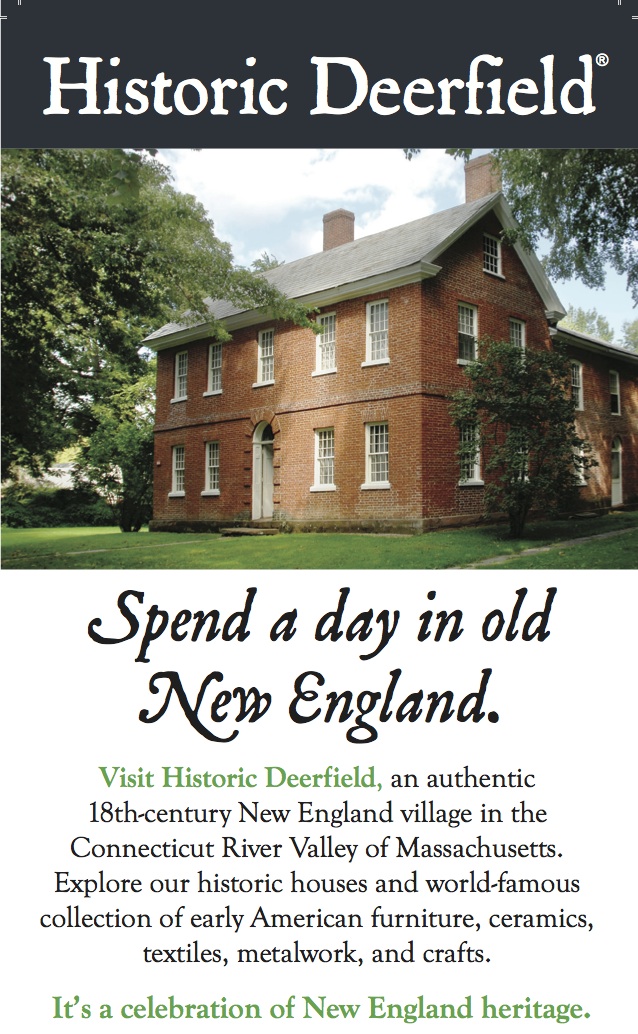
The wording of the advertisement augments this message. By inviting patrons not to learn about Old New England, but to “Spend a Day” there, Historic Deerfield first implies authenticity before bluntly calling itself “an authentic 18th century New England village.” Therefore, there is no need to question the museum’s narrative. Once Historic Deerfield accomplishes the suspension of disbelief, it is free to propagate common myths of New England, the first of which is that it is monolithic.
Geographers, ethnographers, and anthropologists can appreciate the extreme diversity in both landscape and demographics of the six states that form New England. Certainly, the residents of Boston’s Back Bay, as described by Mona Domash, and St. Elizabeth, Vermont as described by Cheryl Morse Dunkley, have vastly different experiences. However, many Americans, and even New Englanders, are content to lump the region together. A striking, albeit non-academic, example is the acceptance of the New England Patriots football team as a representative of all six states. Historic Deerfield Inc. confirms this in the language of the advertisements.
The most pressing example is the museum’s insistence on being a “New England village” rather than a Massachusetts town as displayed above. This implies that the museum could as easily be placed on the coasts of Maine or in the Mountains of New Hampshire to the same effect. In other words, a New England village is a New England village no matter where. While they do eventually place the museum as being in the Connecticut River Valley of Massachusetts, this comes as an afterthought. By referring to itself first and foremost as a New England village, the Massachusetts aspect serves more as geographical direction than cultural definition.
With New England entrenched in patrons’ minds as a homogenous region, the museum pays homage to New England’s reputation as an old and historic location. Indeed, New England stereotypes generally depict the region as resistant to change, with Lewis Mumford proclaiming, “it is the oldest and most persistent seat of human cultere [in America],”1 and Historic Deerfield furthers this opinion. Although those experiencing modernizing forces in New England frequently bemoan the stereotype as counterproductive, Historic Deerfield pays homage through font choices, language, and special events.


The advertisement above combines these “old-time” fonts seen with a subtle, but important relationship between two phrases. On the one hand, Historic Deerfield invites its patrons to spend a day in “Old New England,” yet at the same time, they also represent it as a “celebration of New England heritage.” This conveys that although we have moved into the modern day, New England is still principally defined by its heritage, and is therefore still an “old” region. Furthermore, Historic Deerfield jumps at the opportunity to tie itself to New England’s revolutionary roots and offers history workshops.
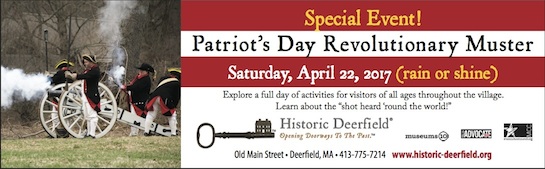
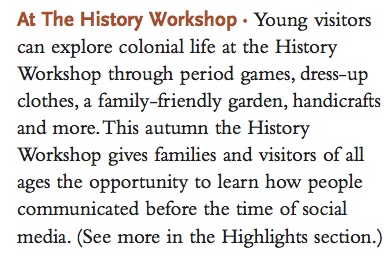
Another integral part of this heritage is the idea of New England as an eternally wealthy, yet refined region that shuns noveau-riche opulence despite an ability to afford it. Much of this image was solidified by the apparent “capacity of the Yankee folk to prevail over the Depression,” as Frost’s New England self-sufficiency seemed to be a bulwark to the banking crisis that many Americans didn’t understand.2 Indeed, Sagendorph emphasized this idea, printing stories about how “marriage to a Yankee brought about cultural and economic salvation.” 3 Yet equally important to this image is the emphasis on Puritan quaintness. While New England may be a wealthy region, its styling was always reserved and tasteful, a reputation currently maintained by housing codes stipulating acceptable building practices in New England towns.
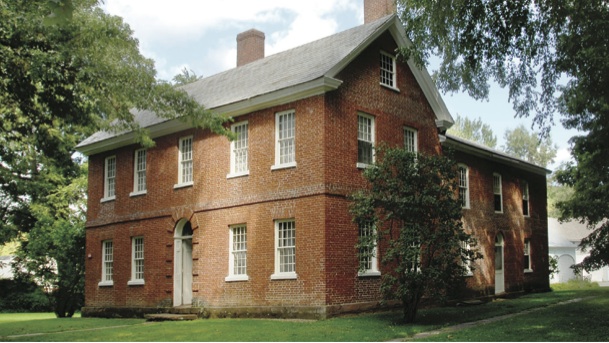

Historic Deerfield propagates this myth by contrasting images of historic homes and furnishings. However, before doing this, a certain amount of mythmaking goes on behind the scenes. While the museum claims these to be realistic representations of New England architecture and crafts, they were the homes and collections of the elite of Deerfield and beyond. Furthermore, these homes have been consistently remodeled and the collections added to, both by private owners before the creation of Historic Deerfield, and by the museum itself. In sum, they present a skewed view on the wealth of both Deerfield, as it portrays the only the town’s elite, as well as New England, in which Deerfield was a comparably wealthy town. They also are sure to reinforce the idea that New England’s wealth and success is not a result of fortune, but of the “Yankee tradition of industry and self-reliance.” 4
Both houses are notable for their size, implying a level of comfort. Furthermore, additions have clearly been added, demonstrating continued prosperity. Yet, the Stebins house is noticeably grander than the Ashley house, with red brick being a more expensive building material than clapboard. However, for a house denoting wealth there are still few unnecessary design features, with the brick formations around the door and running across the middle of the home being the major stylistic touches. Yes, while the homes are large and well furnished insides, the outsides retain the tasteful and reserved appearance integral to the New England myth.
This vision of wealth is also emphasized by specifically selected crafts that Historic Deerfield highlights in its advertising materials.
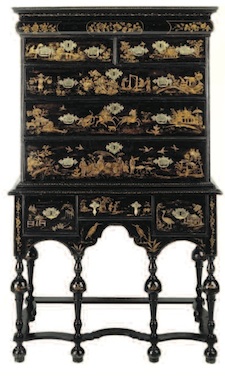
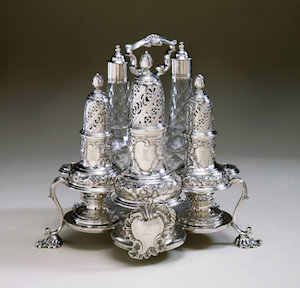
The luxury of the pieces above extends far beyond quaint, and would not be out of place in the home of a European aristocrat consciously emphasizing conspicuous consumption. Certainly, the pieces are a testament to craftsmanship, but certain features are blatantly opulent. The chest’s gold inlay is striking on the black background, and the stand’s intricacy reinforces its status as a luxury utensil. Importantly however, the museum also balances these images with the more refined image of New England that we are used to.
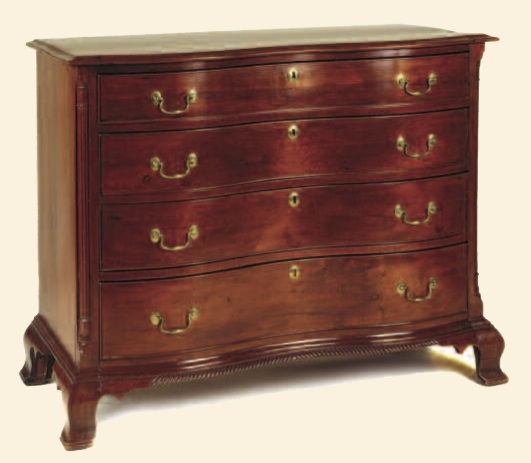
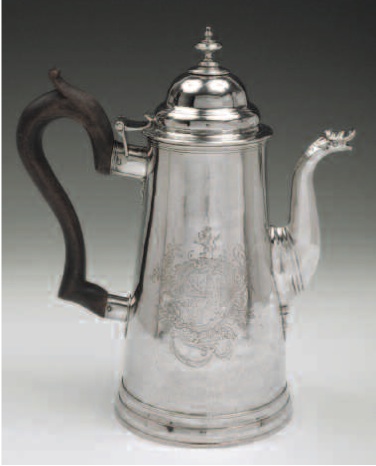
Certainly, these too speak to a certain level of wealth and success. However, they are far more functional, both in use and appearance. The message Historic Deerfield conveys is two pronged: New England was and is wealthy enough to make renovations to their homes and purchase spectacular furnishings with an eye to impress, yet they are not so ostentatious as to overload the exteriors of their buildings or cabinets, and sensible and cultured enough to appreciate more functional designs.
In addition to its role as a cultural institution, Historic Deerfield also serves as a commercial enterprise and, while it is not the main function necessarily, the museum needs to make money to operate. As a result, Historic Deerfield must keep the desires and ideas of the patrons in mind, as much responding to myths as being responsible for them. Indeed, for as much as museumgoers visit with an open mind to learn about New England, they also come to have their opinions and beliefs about New England confirmed. Therefore, In order to attract patrons, the museum must appeal to patrons’ own preconceived notions and capitalize on them. This too is evident, as Historic Deerfield’s advertising responds to ideals by presenting New England as the home of craftsmanship and a bastion of pre-capitalist labor practices, the undisputed home of seasonality and foliage, and a place that values rustic community.
In modern times, many still look to New England as holding on to a greater appreciation of the laborer in the economic process. Unlike the Midwest, marred by auto-production and assembly lines, or the West Coast and its fascination with technology, New England still retains an image of the laborer prior to the alienation of the capitalist process. Many conjure images of the antiquated yeoman farmer hawking self-cultivated produce goods at a town market or the more modern artisan cheese makers described by Heather Paxson. Indeed, these laborers rely on the romantic sentiments felt by their customers to raise prices above what mass-producers offer in an effort to retain profits.
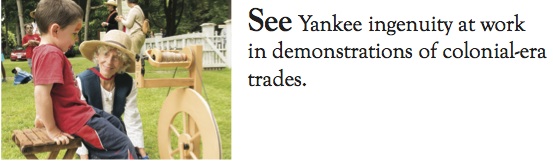
Historic Deerfield is similarly happy to play on these sentiments in their advertisements. These images universally demonstrate one of two qualities of artisan laborer. In performing their craft, those pictured are either intensely engaged or immensely happy. The first speaks to the craft process where one oversees the entire design and creation as Marx might imagine it, an artist performing, and then sharing his or her art with the world.
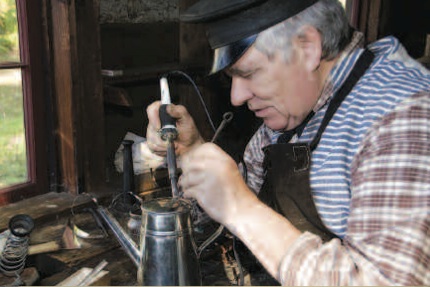
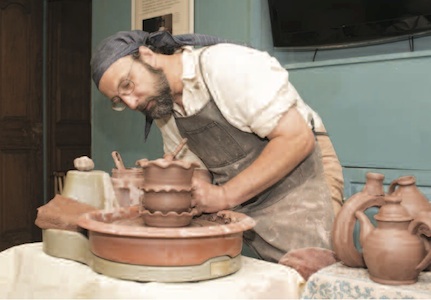
The intensity apparent in the worker’s face and the intricacy of the product appeal to this ideal.
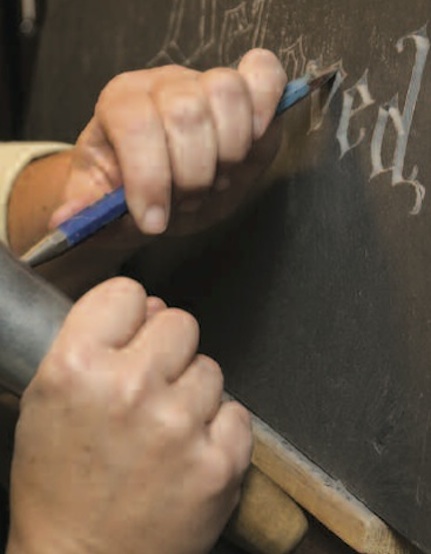
By removing the artisan from the image above, they highlight his skill by emphasizing the importance of his hands and tools. The engraver may as well be holding a paintbrush.
They also allude to this verbally. Take for example their advertisement for the printing process.
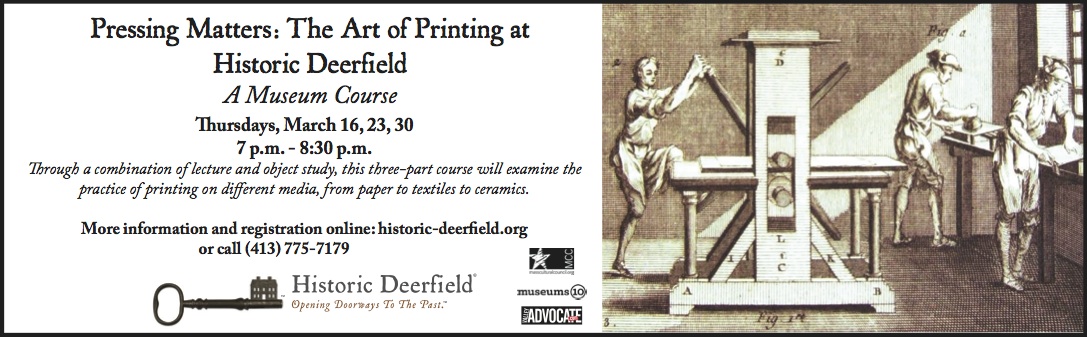
Notice that they do not refer to it as the “Trade of Printing” or the “Job of Printing,” but the “Art of Printing.” Modern printing I doubt receives this same treatment.
Furthermore, when discussing their various collections, they refer to them as a “dazzling collection of masterworks.” While subtle, their choice of “masterworks” indicates the skill of the craftsman and the artistry with which they perform.
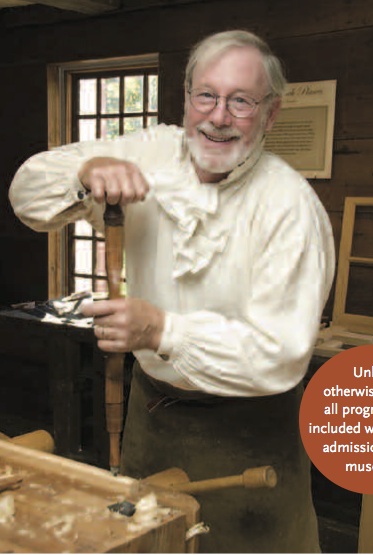
Yet for all the skill the craftsmen demonstrate, they are also clearly happy, as evident in the picture below. One can imagine them receiving the same “rush from the flow of engaged consciousness and focused attention [their craft demands]” that modern artisan cheesemakers interviewed by Heath Paxson describe.5 Indeed, When Historic Deerfield offers trade-learning activities, they are really offering a chance to engage with and experience the joy of pre-alienated labor as it once was and some still wish it to be.
Having fulfilled patrons request to be invited into a world of artisan labor, Historic Deerfield presents it to them in their idealized landscape dominated by seasonality and foliage. The origins of New England’s reputation as the proprietor of foliage can be difficult to place. Certainly, the changing of seasons and leaves is not a uniquely New England phenomenon.


While the images above may remind some of a New Hampshire mountain range or a sleepy Vermont suburb, neither is in New England and one isn’t even in America. Yet, the full experience of the four seasons (and in particular fall) are part of the allure and enduring myth of New England. In a recent New York Times article five of the seven places listed to see the changing of the leaves were in New England, and Historic Deerfield capitalizes on this.
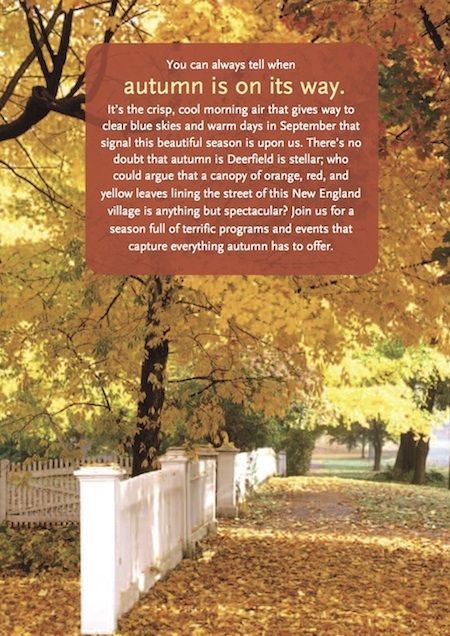
Here, the exceedingly bright glow of the tree leaves contrasts with the darker leaves already fallen to provide blatant visual evidence of New England seasonality, while the text more subtly declares the supremacy of New England foliage. Indeed, by proclaiming, “There is no doubt that autumn in Deerfield is stellar,” and “Who could argue that a canopy of orange, red, and yellow leaves lining the street of this New England village is anything but spectacular?” they leave no room for discussion or dissent – New England is the champion of fall foliage. Furthermore, they emphasize how New England changes as the seasons do, providing seasonal calendars inviting patrons to visit and pay entrance fees multiple times in order to experience all New England has to offer.
Finally, patrons of the museum come expecting the sense of rustic community that characterizes stereotypical New England. This is a particularly interesting notion, as it combines ideas of Yankee self-sufficiency with an emphasis on communal support. Many are swayed by the writings of Frost and Sagendorph, who proclaimed the Yankee as a man who ain’t leanin’ on nothin’ as well as one who understood the value of community, as evident in the Frost poem “A Time to Talk.”
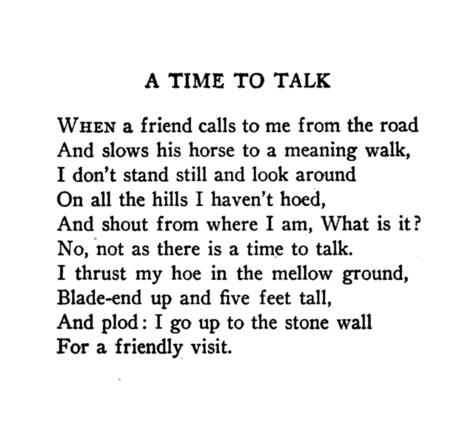
Historic Deerfield satisfies visitors desire to experience this lifestyle with a series of non-location specific activities that they have nonetheless appropriated. Below we see two such activities that they advertise.
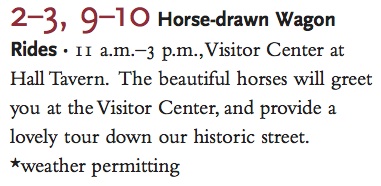
Horse-drawn carriages, while not unfamiliar in New England history, are by no means unique to this landscape. Yet, they fit with the rustic sentiments that many have regarding New England, and are thus offered by the museum. Interestingly, this corresponds with the advertising used by Sagendorph for Yankee Magazine, where “the automobile does not intrude, the horse serving as the preferred mode of transportation.”6
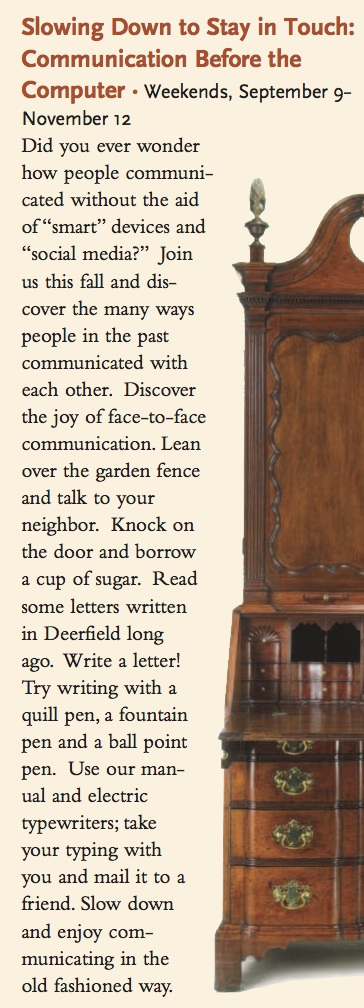
The same can be said for methods of communication. Far from being resistant to advances in communication methodology, the first telephone line ever planted in America started in New Haven, Connecticut. Yet, the idea of pre-modern communications methods playing a more important role in New England versus other regions of the United States has been entrenched by its historical emphasis on town government and Frost, whose poem Mending Wall speaks to its importance.
Historic Deerfield takes these notions and turns them into an enjoyable reprieve from the drudgery of modern life, encouraging patrons to “discover the joys of face-to-face communication,” while portraying a stereotypical New England scenarios of talking to your neighbor “over the garden fence,” emphasizing the pastoral landscape, and “borrowing a cup of sugar” from a neighbor, who do to the communal system of New England town and politics, will only be too happy to oblige.
Museums are incredibly important cultural institutions. They act as the physical embodiment of expertise and understanding. As a result, curators and designers wield an enormous amount of influence over the members of the public who pay to be educated. In this instance, Historic Deerfield uses its position of power to idealize New England, emphasizing the stereotypes that attract many to the region. In this sense, they can be seen as cultural manipulators who willingly deceive their patrons.
However, this is not the view I ultimately wish to present. Indeed, while the portrayal of New England may be both intentional and skewed with customer’s preconceived notions deliberately catered to, that shouldn’t and doesn’t preclude Historical Deerfield from being an extremely valuable historical and geographical resource, and a great way to spend an afternoon.
Cover Photo: The cover photo is taken in front of the Deerfield Inn, one of the historical houses. I obtained it from the museum’s website, and particularly enjoy the view of the steeple in the backleft.
Biography: J. Corey Schiff is a student at Dartmouth College majoring in history. Originally from New York City, he has called New England home for the last eight years and hopes to continue this trend.
Endnotes:
Lewis Mumford, “Orozco in New England,” The New Republic, October 10, 1934, 231. ↩
Joseph Conforti, “Imagining New England: Explorations of Regional Identity from the Pilgrims to the Mid-Twentieth Century,” (Chapel Hill: University of North Carolina Press, 2001), 295. ↩
Ibid, 301. ↩
Ibid, 293. ↩
Paxson, Heather, The Life of Cheese: Crafting Food and Value in America, (Berkely: University of California Press, 2012), 74. ↩
Conforti, “Imagining New England,” 296. ↩