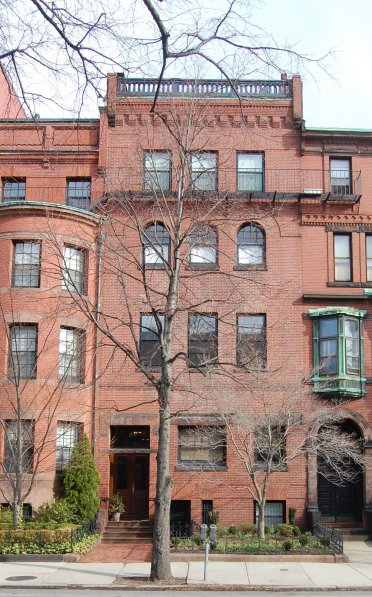
408 Beacon Street was built in 1886 as the home of Dr. Richard Manning Hodges. Hodges was a Professor of Surgery at Harvard Medical School and worked as a breast surgeon at Massachusetts General Hospital.1 As of 2017, the home is inhabited by Dr. Barbara Lynn Smith, a Professor of Surgery at Harvard Medical School and a breast cancer surgeon at Massachusetts General Hospital. Despite the passage of 130 years, the brownstone building is owned by residents with nearly identical professions.
The Beacon Street residence is located in the Back Bay neighborhood of Boston, Massachusetts. The Back Bay residential district consists of 430 acres of urban Boston, extending westward from the Boston Public Garden. Other buildings in Back Bay share similar characteristics with 408 Beacon. The brownstone homes were built in the late nineteenth century for wealthy, well educated, and white residents. 2
Back Bay is a notable example of a neighborhood that has maintained its exclusive character for the duration of its existence. In a city that has undergone profound economic and demographic changes over the past 130 years, including “suburban flight” during the 1970s,3 the Back Bay has remained largely unchanged. The perpetuation of Back Bay’s elite culture is the result of institutions and social policies that inhibit changes in demographics. Institutions and policies such as the Back Bay Architectural Commission, the Boston Zoning Code, Boston Tax Code, and the Boston Public Schools contribute to barriers to social change in the Back Bay of Boston, Massachusetts.
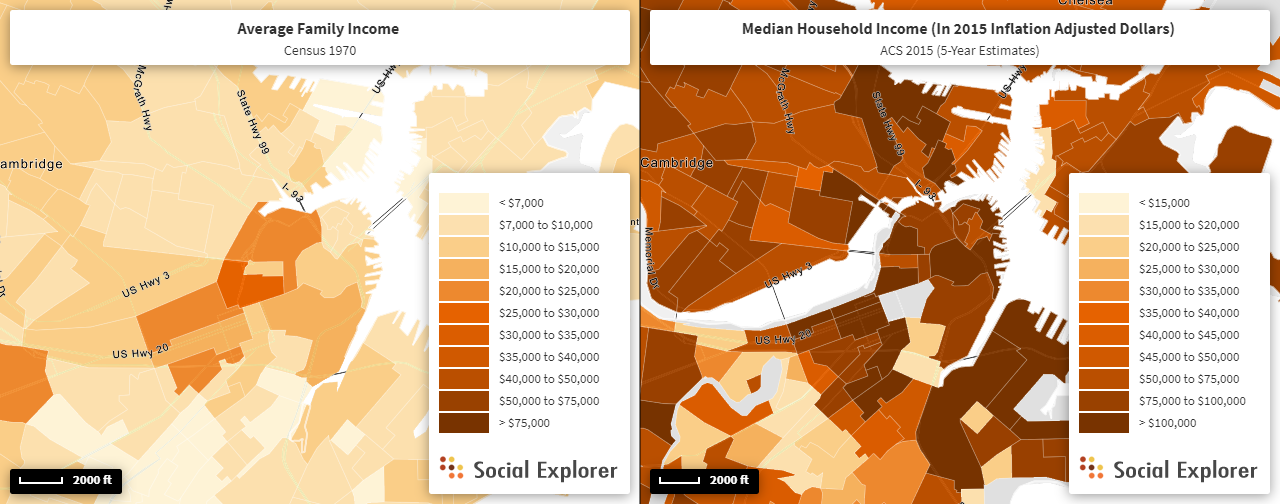
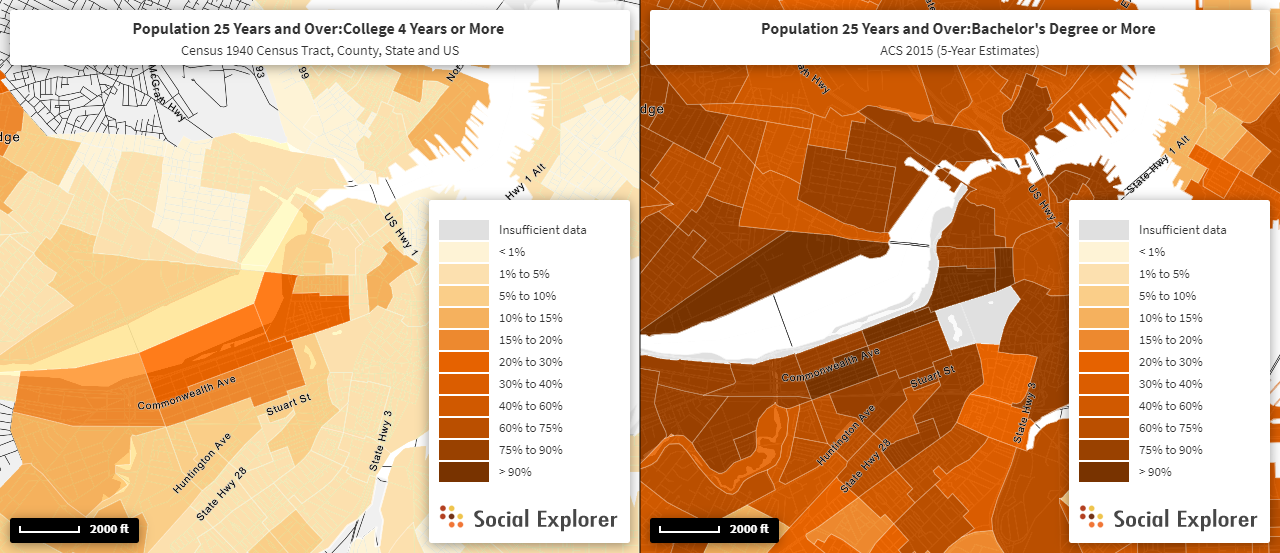
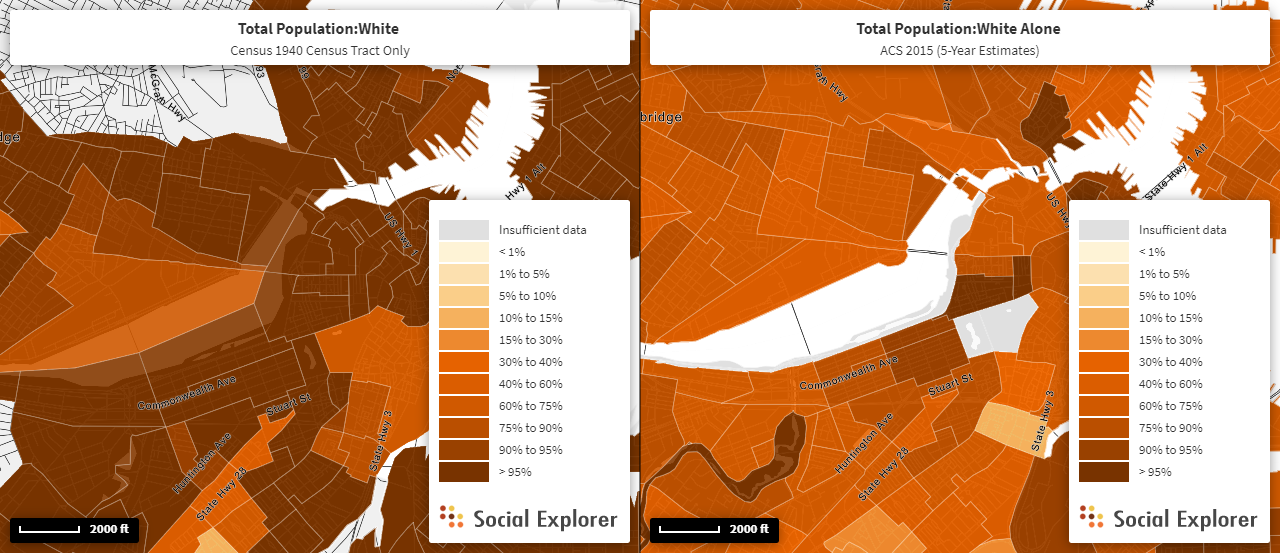
Today, Boston’s Back Bay neighborhood continues to be the home for wealthy, well-educated, and white residents. The figures below show the US Census data of Back Bay for income, education, and race. The first figure shows median household income from 1970 and 2015. Over this time span, the neighborhood has remained in the higher income bracket compared to its surrounding neighborhoods. The second figure shows the percentage of residents in 1940 and 2015 who hold at least a Bachelor’s Degree, illustrating that Back Bay residents have been well-educated over time. Today, Back Bay boasts that nearly 90 percent of its residents hold a Bachelor’s Degree or higher.4 The third figure shows the percentage of residents who are white from 1940 and 2015. Nearly all Back Bay residents were white in 1940, and in 2015 most residents were white—nearly all of the ethnic diversity a result of Asian residents.5
In the early nineteenth century, “Back Bay” was not a neighborhood, but a tidal basin. A dam was built in 1814 by the Roxbury Mill Corporation across the basin to utilize the flowing tidal water for hydroelectric powered mills. The original project envisioned Back Bay as a site for the city’s industrial mills; however, the tidal water flows were inadequate to power industrial factories or even maintain water exchange. Over time, the basin water became stagnant and putrid. By 1849, the Boston Health Department, concerned about the potential health risks, issued an order that the basin be filled in.6
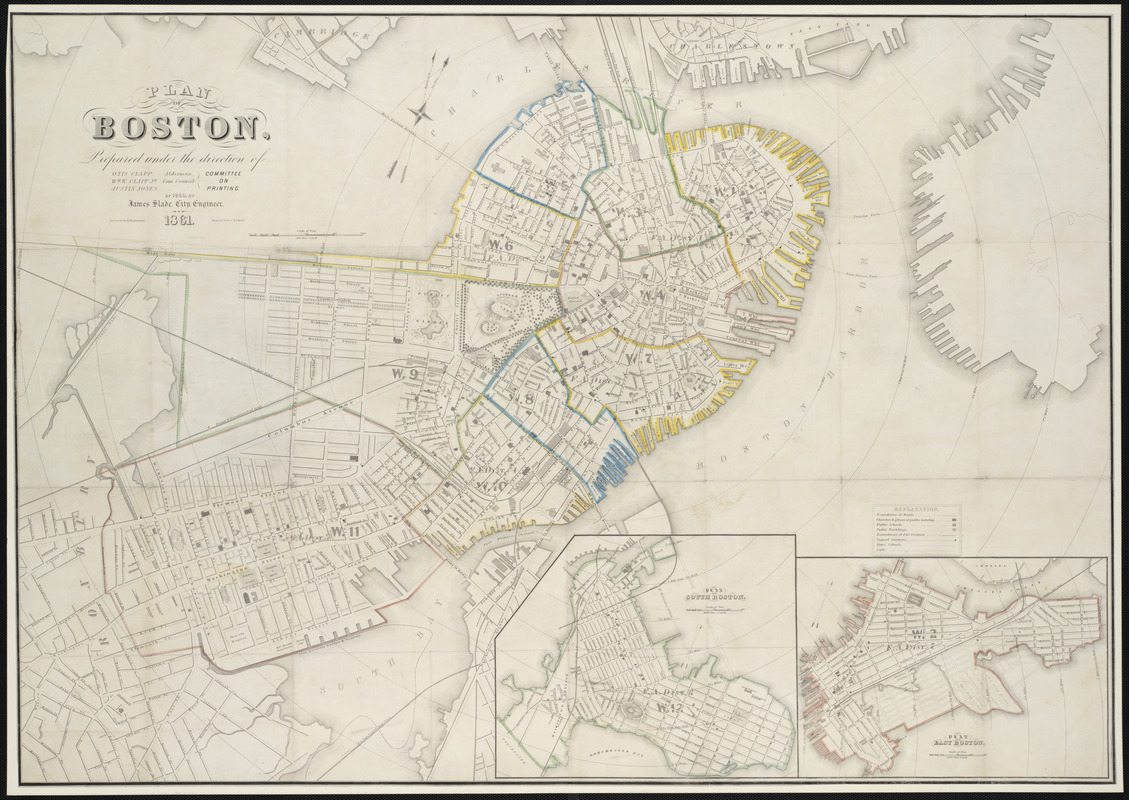
The failure of the Roxbury Mill project led to a unique opportunity for urban planning. From 1857 to 1900, the basin was slowly filled in from east to west. Because most of the surrounding land had already been developed, landfill had to be brought in from towns miles away from the project, such as Needham. The plans for the newly created land consisted of constructing an elite residential neighborhood for wealthy and influential members of Boston society.7 Decisions were heavily influenced by a group called the Boston Associates, who drew their money and influence from their dealings in the Lowell and Waltham mills. The powerful Bostonians wanted a physical foothold in downtown Boston, and they saw Back Bay as the perfect opportunity for their own urban enclave.8
The majority of the houses constructed in Back Bay were Victorian style brick townhouses. The architectural patterns are surprisingly conservative – initial builders were generally wealthy Bostonians who had the resources to build much more ostentatious designs. The primary reason for the modesties of Back Bay architecture was a cultural expectation of Boston elite to represent an enlightened culture concerned with family values and not ruled by capitalist desires.9 The morality expectations are the remnants of Puritan influences in colonial Boston.10
Currently, Back Bay is listed on the National Register of Historic Places as a neighborhood worthy of protection because of its “distinctive characteristics of its architecture and construction.”11 In addition to federal protection, the unique character of the Back Bay has been preserved by local protections from the Back Bay Architectural Commission and the Boston Zoning Code.
The Back Bay Architectural Commission was founded in 1966 to preserve the neighborhood’s exemplary Victorian architecture. Its written purpose in its founding legislation is:
(a) To promote the economic, cultural, educational and general welfare of the public through the encouragement of high design standards for the residential portion of the Back Bay area in the city of Boston; (b) To safeguard the heritage of the city of Boston by preventing the despoliation of a district in that city which reflects important elements of its cultural, social, economic and political history; (c) To stabilize and strengthen residential property values in such area; (d) To foster civic beauty; and (e) To strengthen the economy of the commonwealth and the city of Boston.12
The mandate of the Commission directly suggests that the character of Back Bay is a representation of the character of Boston. The historic preservation that it seeks naturally has ties to older values and ideals. Maintaining the historical legacy implicitly means maintaining the values as well, both the positive and negative elements. Some of the perpetuated ideas are less palatable when explicitly stated. For example, the opposition to physical change in the Back Bay landscape also inhibits increasing diversity. By preserving the “heritage” of Back Bay, some of the nineteenth century ideas about racial and socioeconomic diversity have also been preserved.
An additional component of the Back Bay Architectural Commission is their jurisdiction over any physical changes to buildings in Back Bay. Any resident wishing to make a change to their home must formally apply for their modification, and it must be approved by the committee. A complete application must include a detailed description of proposed work, including an explanation of how the modification will be performed, photographs of all areas that will be affected, and some representation of what the building will look like post modification. Additional specific documentation is required based on the nature of the requested change. In addition to an onerous application process, an application fee must also be submitted. The fee ranges from $25 to $250, depending on the scale of modification requested. Additional aspects of the application also expect monetary resources, such as “you are not required to hire an architect but professional design advice is strongly recommended.”13
The exacting requirements and inherent cost of design review are relative barriers to residents without the luxury of time and money. The difficulty of the application process discourages physical change, but it also implicitly discourages social change as well, by means of monetary and resource based exclusion. Consequently, Back Bay architecture has been preserved, but at the cost of handicaped social development.
An additional mechanism of institutional building restriction is the zoning code. Boston has zoning laws, legislation designed to restrict the type of development that can occur in different areas of the city. Like the Back Bay Architectural Commission, the code includes a statement of purpose, including the intention “to promote the health, safety, convenience, morals and welfare of the inhabitants of the City.”14 Interestingly, the code aims to maintain morals by implementing building restrictions. The wording of the zoning legislation implies that certain types of building would be immoral. The valued morality of Boston harkens back to the traditional Puritan values, where the elite class saw Boston as an enlightened city with high moral regard. The modern-day zoning code still aims to perpetuate the elite cultural values from the nineteenth century.
The Boston Zoning Code restricts the height of buildings, as well as the size of front yards, lot size, and other general characteristics. The object of these restrictions is to maintain uniformity within each district. Exceptions to the code can be made “provided that said Board of Appeal finds that such height will not have a detrimental effect on the neighborhood.”15 The exception process ultimately gives the Board of Appeal power to interpret the phrase “detrimental effect.”
As the zoning code implies, Boston has long been reputed to be a “moral” city. The Puritan morality of Boston is less clear when the zoning code acts to prevent development that could potentially provide social and cultural variety to a historically insular district. Lily Geismer investigates the phenomena with respect to Boston suburbs in her book, Don’t Blame Us. Geismer points out that “Massachusetts had some of the most extensive fair housing laws in the nation, but the statutes had no over-sight over local zoning ordinances.”16 Although she is referring to the suburbs of Newton and Concord, the same concept applies to Back Bay. Zoning code is an effective mechanism to halt development of affordable housing that could increase socioeconomic and racial diversity.
Boston is known for its high home values and high property taxes. The 2017 Boston property tax rate was $10.59 per $1,000 of residential property value.17 Although the property tax rates are modest, home values in Boston are more than twice the US house-price index.18 The 2017 Massachusetts state income tax was 5.1%.19 Relative to other American cities, Boston has an effectively higher property taxes and lower income taxes. The consequence of higher property values is that it contributes to the geographical restriction of low income residents.
In the Back Bay neighborhood, the median home value is $935,000.20 At the current property tax rate, the average annual property tax is nearly $10,000. For many Bostonians, the financial barriers to buy a home in Back Bay are simply too high. The property taxes alone would be 14% of the $71,000 median household income in Massachusetts.21 The property tax is unaffordable for most households; for most, high property taxes is regressive and geographically limiting.
A tax regime with high property taxes is not the only option. A revenue neutral tax policy could include a higher income tax rate and a lower property tax rate. In this case, property values would not create a long-term obstacle for socioeconomic inclusion based on property tax rates. A reasonable speculation is that a reformulated tax policy would be less regressive and could foster residential neighborhood inclusivity.
The unaffordably high home values and property taxes have discouraged the influx of low income residents into the Back Bay. Because of these economic forces and practical realities, Back Bay has remained a neighborhood of almost exclusively wealthy residents.
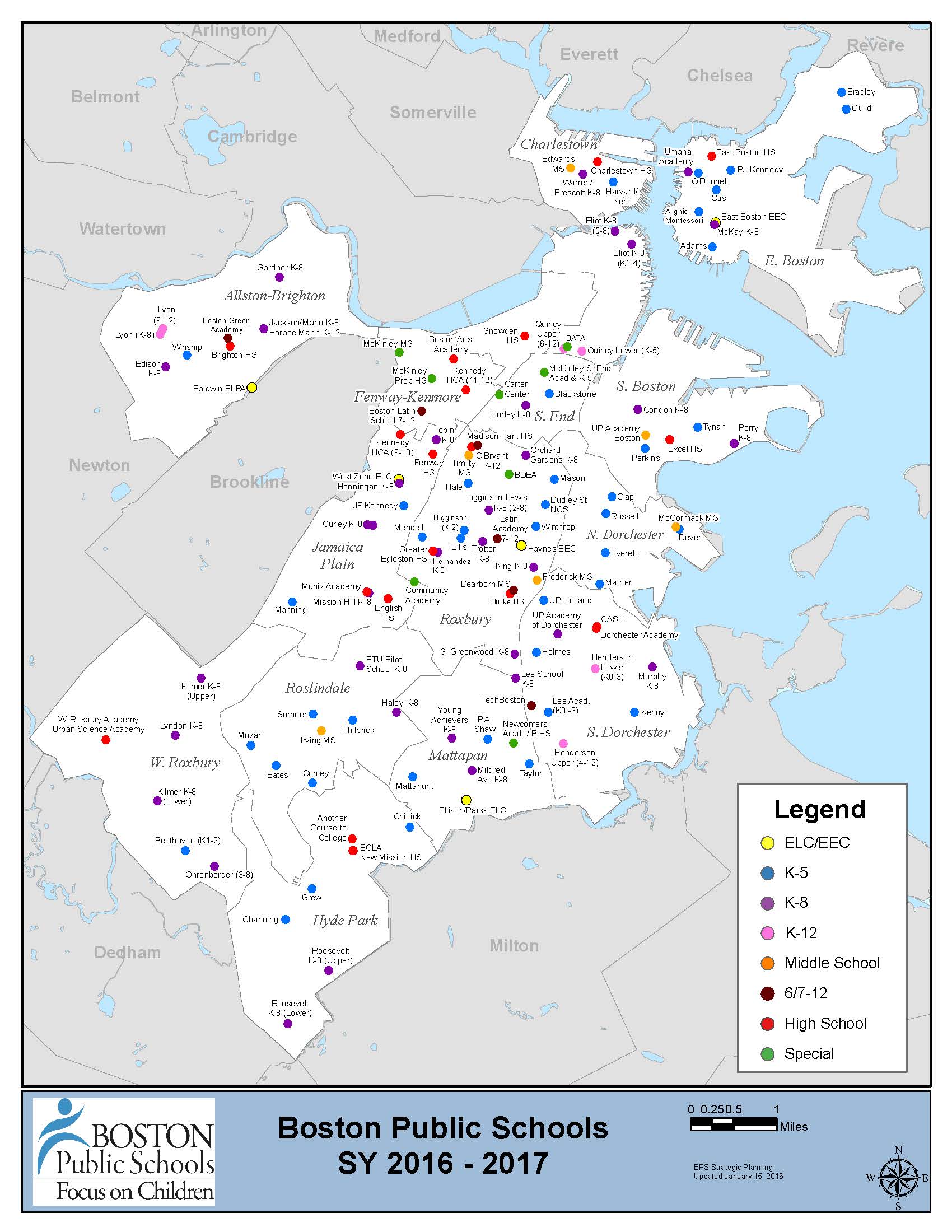
Back Bay does not contain public school resources. As the figure to the right shows, the map of Boston Public Schools is noticeably bare in the Back Bay region. The single school listed in the Back Bay area, a high school named “Snowden International School at Copley,” is lauded by the Boston Public Schools website as having a “demanding college preparatory curriculum and a focus on global studies,”22 but in reality falls at or below average in most categories of the Boston Public Schools’ School Quality Report.23 Furthermore, the closest available public schools for elementary school students do not have busing options in the Back Bay neighborhood.24
The lack of public school availability and transportation is a significant barrier for young families with a limited budget. From personal experience, most Back Bay residents send their children to independent private schools. The disadvantage of private schools in the Boston area is that they are often very expensive. For example, the Commonwealth School is a small, private high school located in Back Bay. The tuition for the 2017-2018 school year is a staggering $42,900; that is, over 60% of the median household income in Massachusetts. Only 30 percent of their students are reported to receive any financial aid.25
The lack of public schools, particularly for grade school aged students, creates socioeconomic barriers. Families who cannot afford the high tuition prices of private schools are effectively discouraged from living in Back Bay. The Back Bay neighborhood is much more practically accessible to residents who can afford to send their children to private schools. These limited educational opportunities reinforce Back Bay’s traditionally wealthy background and inhibit socioeconomic diversification.
Both physically and socially, Back Bay is a remarkably well-preserved example of a nineteenth century Boston neighborhood. Policies and institutions such as the Back Bay Architectural Commission, the Boston Zoning Code, Boston Tax Code, and Boston Public Schools have reinforced Back Bay’s heritige as an elite residential district. Barriers to socioeconomic diversification have maintained the wealthy, white demographic of Back Bay. Ultimately, these forces have led to 408 Beacon Street being inhabited by Harvard Professors of Surgery with nearly identical occupations—despite the separation of over a century in time.
While Back Bay is only a small residential district in Boston, the obstacles to change illustrated by the neighborhood are not unique. Institutions and policies designed to preserve physical landscapes also tend to preserve social landscapes as well. The preservation of historical neighborhoods serves an important cultural purpose, but the social ramifications cannot be ignored; socioeconomic and racial diversity is beneficial to culture as well. The costs of maintaining a neighborhood like Back Bay may ultimately be much higher than simply preserving an exemplary neighborhood of Victorian architecture.
Kaleigh Mentzer is a student at Dartmouth College studying Physics and Economics. In her spare time she competes for the Dartmouth Fencing Team and the Boston Fencing Club.
Cover Photo: “Commonwealth Avenue.” Photograph. 1880. Digital Commonwealth, http://ark.digitalcommonwealth.org/ark:/50959/66830618j (accessed October 19, 2017).
“Back Bay At a Glance.” Boston Planning and Development Association. Accessed November 13, 2017. http://www.bostonplans.org/neighborhoods/back-bay/at-a-glance.
“Back Bay History.” Neighborhood Association of the Back Bay. Accessed October 19, 2017. http://www.nabbonline.com/.
“Instructions for Completing an Application for Certificate of Appropriateness/Design Approval/Exemption.” City of Boston. 2017. Accessed November 11, 2017. https://www.boston.gov/sites/default/files/document-file-02-2017/desrev_application_instructions_and_fees_for_all_commissions_revised_2017.pdf.
“Learn about Massachusetts Tax Rates.” Mass.gov. Accessed November 14, 2017. https://www.mass.gov/service-details/learn-about-massachusetts-tax-rates.
“National Register of Historic Places.” National Parks Service. Accessed November 13, 2017. https://www.nps.gov/nr/.
“School Listings.” Boston Public Schools. Accessed November 13, 2017. http://www.bostonpublicschools.org/.
“Snowden International School at Copley.” Boston Public Schools. Accessed November 13, 2017. https://www.bostonpublicschools.org/Page/922.
“Tuition and Financial Aid.” Commonwealth School. Accessed November 13, 2017. http://www.commschool.org/admissions/tuition-and-financial-aid. Back Bay Houses. Accessed October 19, 2017. https://backbayhouses.org/.
Boston (Mass.). Park Commissioners. “Back Bay park.” Map. 1877. Norman B. Leventhal Map Center, https://collections.leventhalmap.org/search/commonwealth:js956k89q (accessed October 19, 2017).
Boston Redevelopment Authority. Zoning Code of the City of Boston, Massachusetts. 2017.
BPS School Quality Report: Snowden International School at Copley. Report. MA Consortium for Innovative Education Assessment. Accessed November 13, 2017. https://www.bostonpublicschools.org/site/handlers/filedownload.ashx?moduleinstanceid=1526&dataid=13164&FileName=Student-Teacher%20Climate%20Report%20SnowdenIntlHS.pdf.
Bunting, Bainbridge. Houses of Boston’s Back Bay: An Architectural History. Cambridge, MA: Belknap Press of Harvard University, 1967.
City of Boston. “Residential & Commercial Tax Rates.” Boston.gov. Accessed November 14, 2017. https://www.boston.gov/sites/default/files/imce-uploads/2017-09/2017_taxrates3q.pdf.
Domosh, Mona. Invented cities: the creation of landscape in nineteenth-century New York and Boston. New Haven: Yale University Press, 1998.
Geismer, Lily. Don’t Blame Us. Princeton, NJ: Princeton University Press, 2014. Median Household Income, 2015 and 1970. Social Explorer, (based on data from U.S. Census Bureau; accessed Nov 13, 2017).
Population 25 Years and Over; Bachelor’s Degree or Higher, 2015 and 1940. Social Explorer, (based on data from U.S. Census Bureau; accessed Nov 13, 2017).
Suarez, Ray. “The Old Neighborhood: What We Lost in the Great Suburban Migration, 1966-1999.” New York Times, 1999. Accessed November 15, 2017. http://www.nytimes.com/books/first/s/suarez-neighborhood.html.
Swasey, Benjamin. “Mass. Household Income Jumped Nearly 6 Percent in 2016.” WBUR. September 14, 2017. Accessed November 15, 2017. http://www.wbur.org/bostonomix/2017/09/14/massachusetts-income-poverty.
Total Population; White Alone, 2015 and 1940. Social Explorer, (based on data from U.S. Census Bureau; accessed Nov 13, 2017).
United States. City of Boston. Chap. 625. An act creating the Back Bay Residential District in the City of Boston, and establishing in the Boston Redevelopment Authority the Back Bay Architectural Commission and defining its powers and duties. Boston, MA, 1966.
Zillow, Inc. “Back Bay Home Prices and Values.” Zillow. Accessed November 14, 2017. https://www.zillow.com/home-values/.
“Back Bay Houses.” Accessed October 19, 2017, https://backbayhouses.org/. ↩
“Back Bay History.” Neighborhood Association of the Back Bay. Accessed October 19, 2017, http://www.nabbonline.com/. ↩
Ray Suarez, “The Old Neighborhood: What We Lost in the Great Suburban Migration, 1966-1999,” New York Times, 1999, accessed November 15, 2017, http://www.nytimes.com/books/first/s/suarez-neighborhood.html. ↩
“Back Bay At a Glance,” Boston Planning and Development Association, accessed November 13, 2017, http://www.bostonplans.org/neighborhoods/back-bay/at-a-glance. ↩
“Total Population; White Alone and Asian Alone, 2015 and 1940.” Social Explorer, (based on data from U.S. Census Bureau, accessed Nov 13, 2017). ↩
“Back Bay History.” Neighborhood Association of the Back Bay. ↩
Domosh, Mona. Invented cities: the creation of landscape in nineteenth-century New York and Boston (New Haven: Yale University Press, 1998), 104. ↩
Domosh, 101. ↩
Domosh, 115. ↩
Bainbridge Bunting, Houses of Boston’s Back Bay: An Architectural History (Cambridge, MA: Belknap Press of Harvard University, 1967), 3. ↩
“National Register of Historic Places,” National Parks Service, accessed November 13, 2017, https://www.nps.gov/nr/. ↩
United States, City of Boston, Chap. 625. An act creating the Back Bay Residential District in the City of Boston, and establishing in the Boston Redevelopment Authority the Back Bay Architectural Commission and defining its powers and duties. (Boston, MA, 1966), 594-595. ↩
“Instructions for Completing an Application for Certificate of Appropriateness/Design Approval/Exemption,” City of Boston, 2017, accessed November 11, 2017, https://www.boston.gov/sites/default/files/document-file-02-2017/desrev_application_instructions_and_fees_for_all_commissions_revised_2017.pdf. ↩
Boston Redevelopment Authority. Zoning Code of the City of Boston, Massachusetts, 2017, Section 1-1. ↩
Zoning Code of the City of Boston, Massachusetts, Section 16-4. ↩
Geismer, Lily. Don’t Blame Us (Princeton, NJ: Princeton University Press, 2014), 186. ↩
City of Boston, “Residential & Commercial Tax Rates,” Boston.gov, accessed November 14, 2017, https://www.boston.gov/sites/default/files/imce-uploads/2017-09/2017_taxrates3q.pdf. ↩
Inc. Zillow, “Back Bay Home Prices and Values,” Zillow, accessed November 14, 2017, https://www.zillow.com/home-values/. ↩
“Learn about Massachusetts Tax Rates,” Mass.gov, accessed November 14, 2017, https://www.mass.gov/service-details/learn-about-massachusetts-tax-rates. ↩
Inc. Zillow. ↩
Benjamin Swasey, “Mass. Household Income Jumped Nearly 6 Percent in 2016,” WBUR, September 14, 2017, accessed November 15, 2017, http://www.wbur.org/bostonomix/2017/09/14/massachusetts-income-poverty. ↩
“Snowden International School at Copley,” Boston Public Schools, accessed November 13, 2017, https://www.bostonpublicschools.org/Page/922. ↩
BPS School Quality Report: Snowden International School at Copley, report, MA Consortium for Innovative Education Assessment, accessed November 13, 2017, https://www.bostonpublicschools.org/site/handlers/filedownload.ashx?moduleinstanceid=1526&dataid=13164&FileName=Student-Teacher%20Climate%20Report%20SnowdenIntlHS.pdf. ↩
“School Listings,” Boston Public Schools, accessed November 13, 2017, http://www.bostonpublicschools.org/. ↩
“Tuition and Financial Aid,” Commonwealth School, accessed November 13, 2017, http://www.commschool.org/admissions/tuition-and-financial-aid. ↩